This fun is very serious business…
The artists, featured in December 2025 exhibitions at KCAC Some Assembly Required and Your Digital Holiday build their artworks from a variety of singular elements in ways that embrace novel novelty - as the artists’ inventive approaches make the familiar feel newly alive.
One artist creates repetitive marks on discrete pieces of wood to indirectly construct an image; another mines the scrap heap of defunct popular culture to assemble a fresh investigation of the present; and another designs elements digitally before bringing them into the physical world; building images from preplanned, standardized grids .
In each artists practice, play is essential—proof that the most serious work often begins in curiosity, experimentation, and the joy of making.
Kansas City artist Dick Daniels is known for his commercial and fine artworks, especially his Funhouse 57 line of playful early-20th-century-animation-inspired signs, banners, drinkwear and ceramics. Daniels, whose motto is “If it’s not fun, don’t do it,” maintains that playful spirit in his approach to his abstract pieces: painting thin blocks of birchwood with graphic shapes. Like the toy blocks of youth, each piece is then assembled into a whole composition , aggregating them in intuitive, unexpected ways.
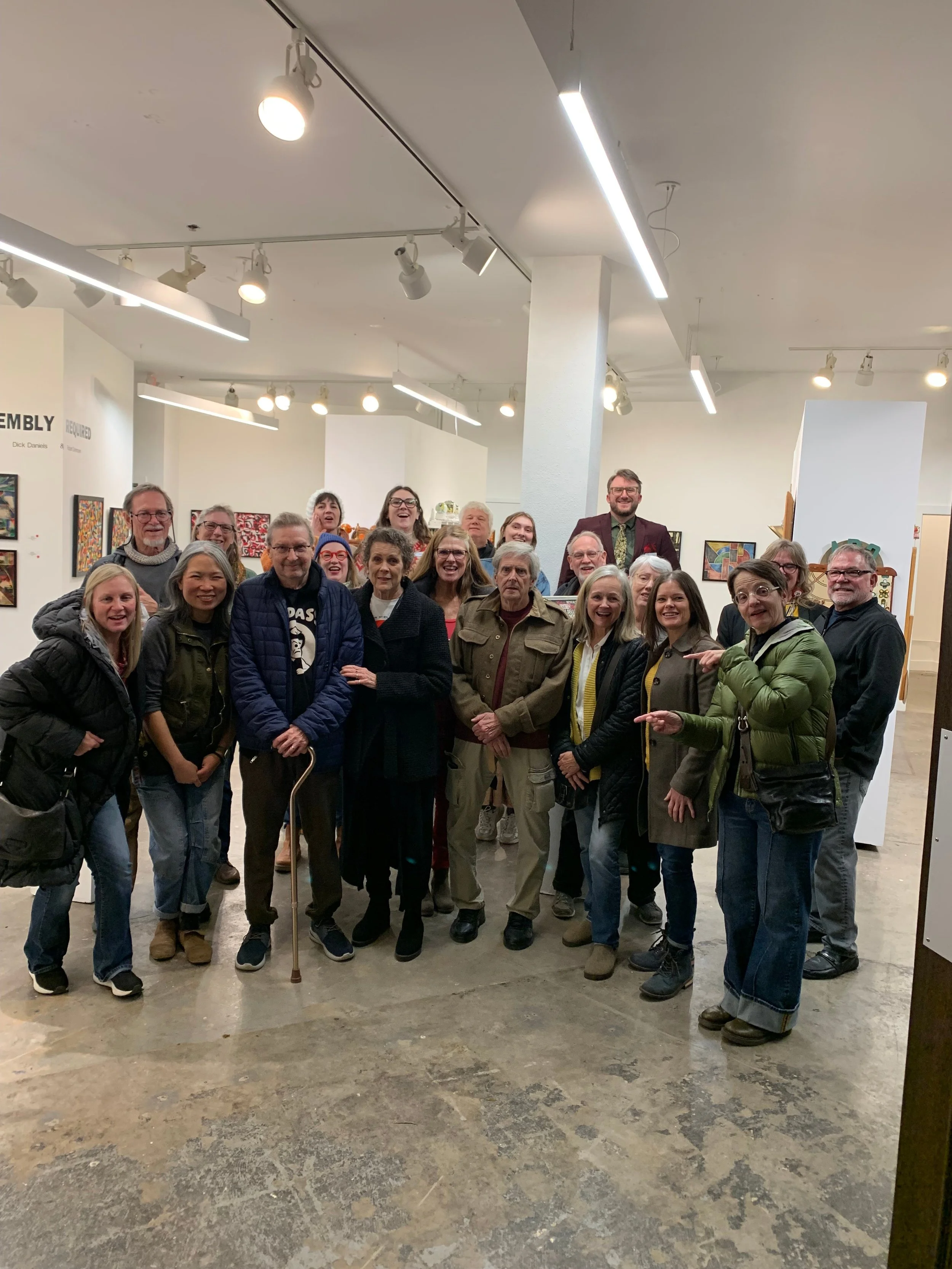
KCAC Staff with friends and family of Dick Daniels, Bob Dohrmann and Mike Webb during the opening reception in December 2025
“I have no idea how they will turn out,” Daniels says, “and it’s always a surprise.”
The final compositions are at first glance bright, intense high-energy, high- graphic statements, reminiscent of 60s jazz record sleeves or the rubbery figurations of Fleischer cartoons. Spending more time with the pieces, one finds, as with Sister Corita Kent’s prints, more layers, more nuance, and more depth. These pieces shout out to bring you in, then hold you with there close quiet, but arresting conversation.
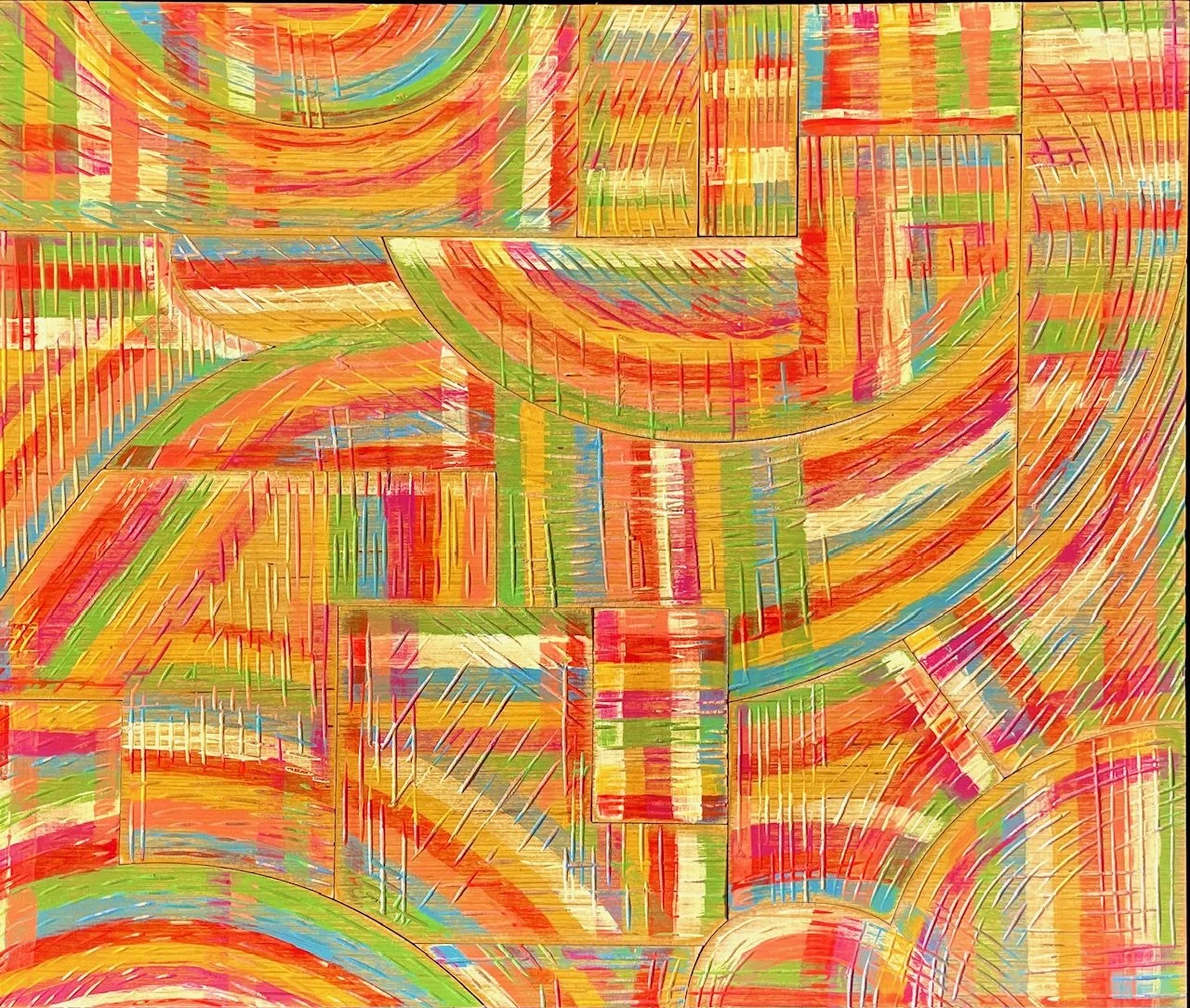
Sunshine by Dick Daniels; Paint on wood, assemblage 21x18x1 inches
Oklahoma artist Robert Dohrmann builds his work quite differently from Daniels. Dohrmann frequents second hand stores, thrift shops, and flea markets, “rummaging through graveyards of consumable ‘goods’ re-swapped for more $$ in thrift stores. Cheap consumer goods gain new life, again to adorn the walls and tables of mainstream America. Inspiration in the cheap stuff of yester-year re-arts mass-produced things with façades of style and class.” Dohrmann cuts, pastes, snaps, and fastens his pieces, creating 2- and 3- maximalist works examining and reassessing the development and explosion of 20th century culture, scrutinizing the past in order to find out how we got where we are today.
Similar to Daniels’ abstractions Dohrmann’s work brings in the viewer and holds them, but in a markedly different way. Dohrmann’s assemblages are an exercise in scale, proportion, composition, and dimension; his pieces amass giant magazine-ad heads on tiny action figures, dangling corded computer mice and dollhouse frames. Faces are split but still smiling, and open vanity frames are transformed into triptych altarpieces for the church of mass consumption, all priced to move at a few hundred dollars and 99 cents. The viewer is caught in a roiling kaleidoscope of half remembered famous faces, rosy cheeked ad girls, and vividly printed wallpapers. Dohrmann’s work traps you in a stream of beautiful ephemera, half remembered soft drink jingles, and Sears catalog reminiscence.

Work from Michael Webb’s exhibtion
With a background spanning graphic design, photography, and painting, Kansas City–based artist Michael Webb has developed a signature grid-and-pixel style that transforms retro visual language into vibrant, contemporary art.
Grids abound in Webb’s first solo show at KCAC. reminiscent of 18 bit video games, he presents a collection of both digitally rendered and hand painted grids, presented at impressive scale. one wall of the gallery is covered almost floor to ceiling with 16 24’ square digitally made grids- a literal grid of grids. Elsewhere, Webb underlines the playful video game influence of his work with Mega-Zilla vs Cities, a 6'x3’ canvas depicting a fire breathing monster, glimpsed between the gap of 2 grid-high rises. Also on show are unique printed weaves - digitally designed strips that are cut, arranged, and interlaced by hand. These woven works echo the grid while introducing a tactile, dimensional quality that connects the digital with the physical.
His art explores the intersection of structure and play, where the precision of geometry collides with expressive color and rhythm. Influenced by modernist pioneers and the aesthetics of early computing, Webb reimagines digital culture as both history and future—capturing the joy, curiosity, and complexity of the human experience in a world shaped by technology.
Each artist on exhibition this December is invested in building work from parts, to create a greater whole. Each artist is also heavily influenced by the history of both popular culture and fine art, quoting from, alluding to, or appropriating extant imagery and artifacts from the past. Although these artists approach art making with these similar foundations, the work of each of them is vastly different. as in their individual works the bringing toghether of the art from these three artists builds an exhibition for which the whole os greater than the sum of the parts.