By Thayer Bray November 2026
I think a lot about the difference between being aware of a work of art and being present with it. Most of the art I consume is via reproduction, mostly in books, then on screens. Being a printmaker, I have the privilege of seeing much of the Old Master work I love in high-fidelity black and white, at 1:1 scale; and with the increase in fidelity of print reproductions, I think I can get a good idea of the full-color contemporary art reproduced on the page.
In point of fact, in college, as perpetually broke students, several of my friends and I smugly asserted that—in spite of making physical art ourselves—reproduction was sufficient and seeing art in person was a superfluous exercise. (This was probably borne from a subconscious recognition that all the “great art,” housed out of state and out of country, was out of reach and impossible to witness firsthand anyway.)
After college, I was visiting friends and family in New York and made a trip to the Metropolitan Museum of Art. Wandering through the galleries, I entered a room, looked to my left, and stopped dead. Growing up, I had seen the painting dozens of times in history books, reproduced as a ~1.5 x 3 inch rectangle on glossy white sheets. In the gallery, I was enveloped, dominated, and consumed by the explosive, torrential painting Washington Crossing the Delaware. Twelve feet by 21 feet, 28 square yards of immersive, active art. I had seen theater screens smaller than this painting. The colors, textures, composition, figuration writ large. The scale, skill, and ambition of the painting struck me dumb. My understanding of the work, reproduced throughout my life, was obliterated and replaced with this real, physical, leviathan monument.
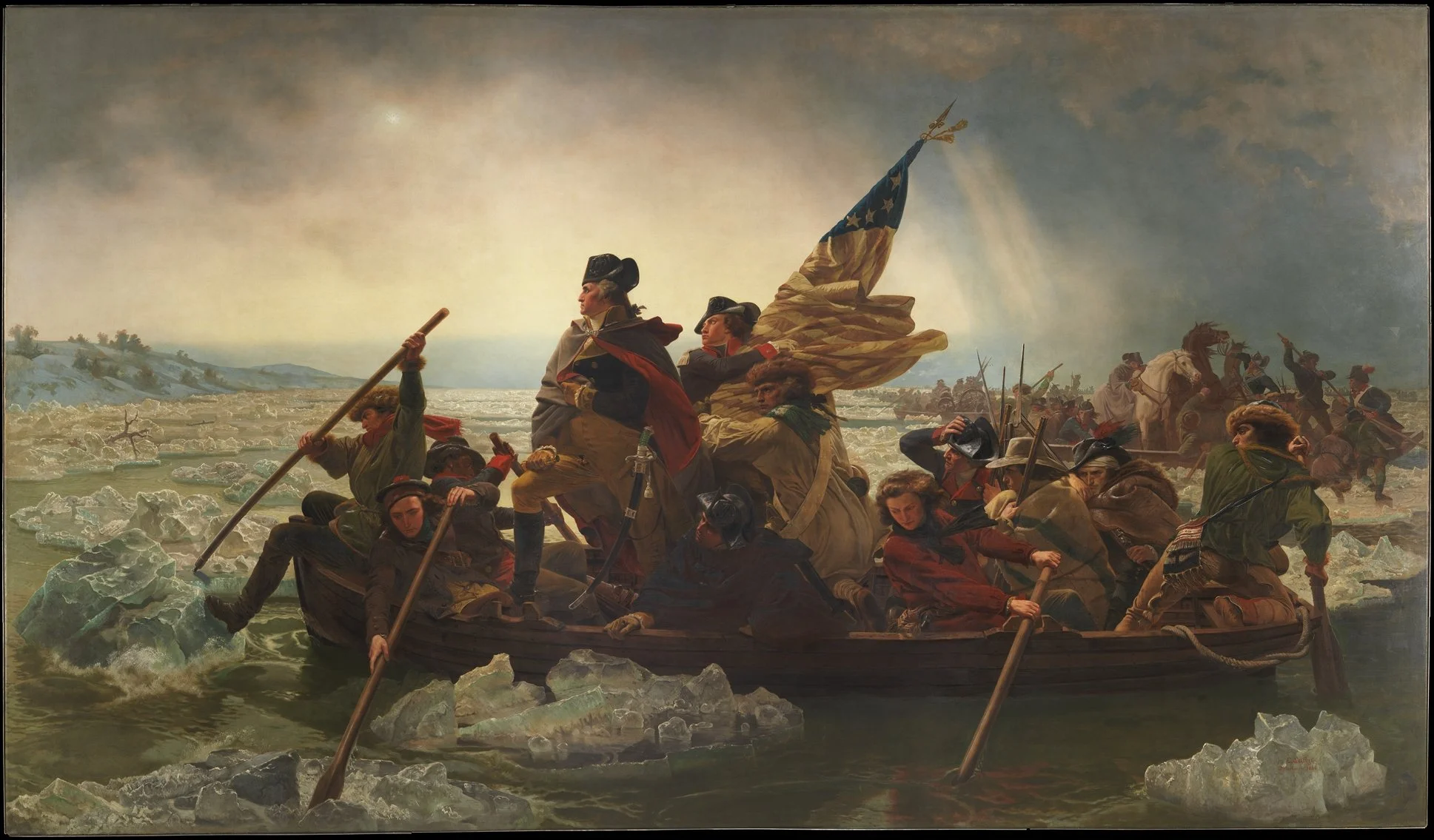
Washington Crossing the Delaware. Emanuel Leutze, German American. 1851We live in a world saturated with images. We see more images in a day than people 100 years ago saw in a month, than many people 1,000 years ago saw in several lifetimes. Nearly all of these images, still and moving, are mediated, chopped, and reformatted to a 2.5 x 5.5 inch screen. We view and experience the world through the dictates of these screens, and therefore through the organizations that make them. And our experience of this standardized information vector renders everything we see on them experientially identical. The $1.2 billion IMAX movie is the same experience as the Rembrandt etching is the same experience as a FaceTime call to a loved one is the same experience as the latest meme-culture BuzzFeed listicle is the same experience as the livestreamed sermon is the same experience as an advertisement that dentists don’t want you to know about. As our experiences are channeled and standardized, so are our views of the world and our ability to be controlled. We are not, however, digital entities, but living beings, and as such we need real, living experiences to thrive.
When we behold a piece of art in physical reality, we don’t simply see it; we experience it in a very visceral way. We meet it on its terms; it is an entity we exist with and interact with, not just a thing to see or hear. We walk around it, step close, step away, crane our necks, squint, lean, shift our weight as we feel the floor pushing against our feet. Un-pocket our hands and cross our arms. Stand, sit, think, absorb. We are pulled into the depth of field or pressed against the flat plane of the substrate. Circle around its bulk as it reveals new sights and forms at each angle. Slip along the joy or solemnity of the colors, feel the bass vibrate the hollows of our chest. Dilate in the dark and squint in the dazzle of the light. The primary mediation of our experience is the boundaries of our senses.
In reproduction, we can experience delight, fascination, boredom, awe, reverence, desire. But to experience a work—the assertive existential fact of a piece of art—we must be present, our animal bodies occupying the same real, proximal space. Witnessing art firsthand doesn’t just help us see the work more clearly; witnessing art firsthand facilitates our knowing the work, and ourselves, on a fathomlessly deep level.

The Distance Between… , Installation View, M. Willie Garcia
Being present with art is vitally, deeply important. As the Director of Exhibitions for KCAC, I have seen nearly 250 exhibition proposals and over 1,000 pieces of art, first as little tiles on this computer screen, then in person, in my hands, nailed to the wall, pressed against my person before I set them on pedestals. With every piece I am present with, I am stricken with amazement. In spite of the months I could spend with a JPEG on my screen, in my files, through my emails, I am never prepared for the excitement and discovery of experiencing a piece of art in person. The texture, color modulations in this or that light, the scale, dimensionality, materiality. How the piece sways in the turbulence of a passing body. How a projection warps and directs on a wall. The two minutes and 30 seconds of sound, looped for six weeks straight, that one grows to notice only when it stops playing. These can, maybe, be pictured, to greater or lesser degrees, on a screen, but only through presence can they be experienced, felt, known.
Seeing is believing, and experiencing is knowing.
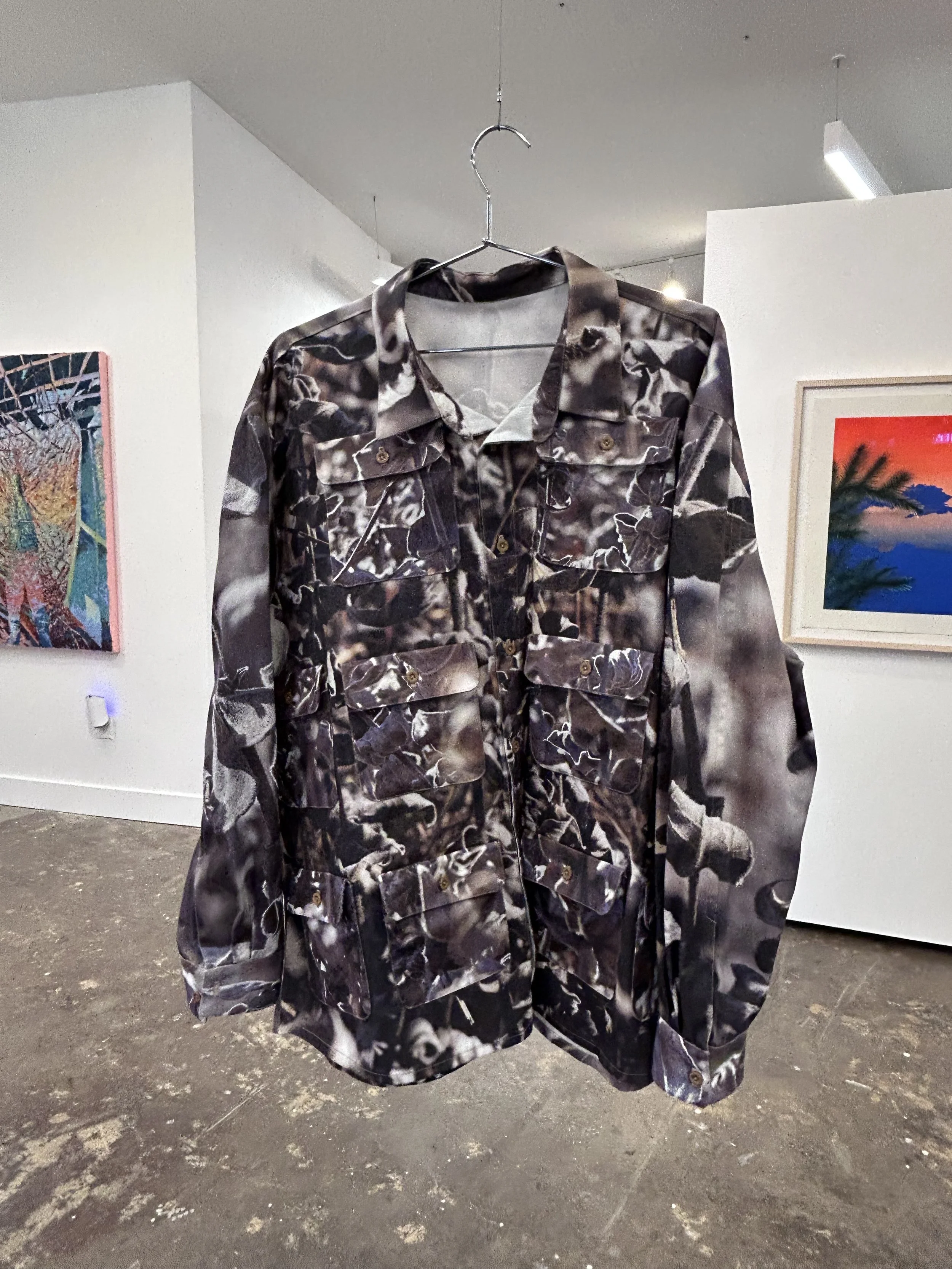
Second Skin (detail) by Justin Korver, Digital Print on fabric