Edge Effect, 3 person exhibition Kevin Kelly, Justin Korver, Tim Stone
Main Gallery, September 18 – November 6, 2026
Opening Reception: First Friday, October 2, 2026, from 5:00 – 9:00 PM
Closing Reception: First Friday – November 6, 2026, 5:00 – 8:00 PM
The three artists in Edge effect are most concerned with the collision between suburban and rural space. The paintings of both Kevin Kelly and Tim Stone depict the porousness fo this barrier: Cola vending machines sitting in scrubby underbrush, deflated tube men lying in cracked and weed-festooned parking lots, wooden structures whose lath opens up into neon skies. Justin Korver’s installations lead us further into that other-than-human land with immersive sights, sounds and even smells.

When it Comes to Ghosts There is Always Room for One More by Kevin Kelly, colored paper pulp on felt
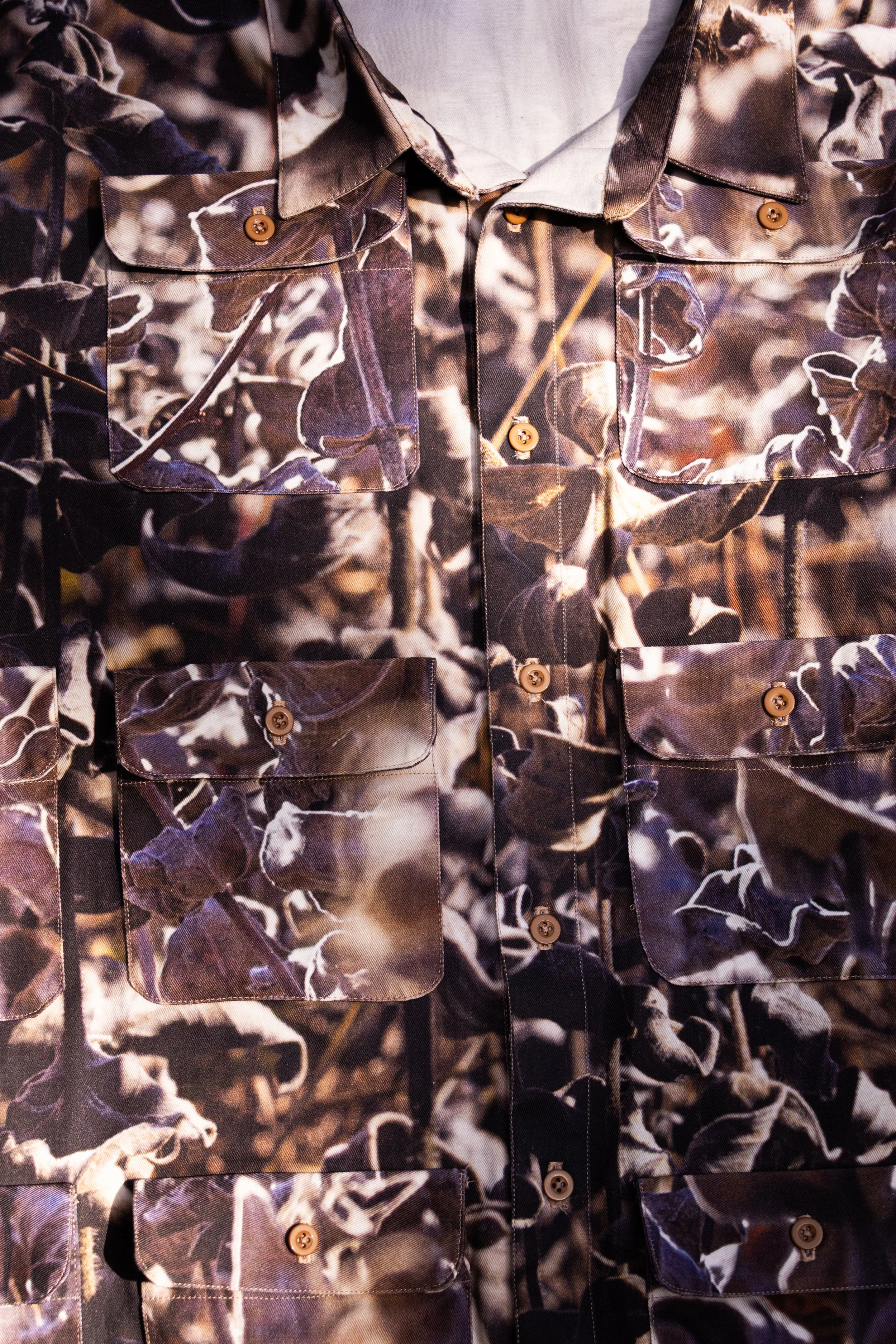
Second Skin (detail) by Justin Korver, Digital Print on fabric
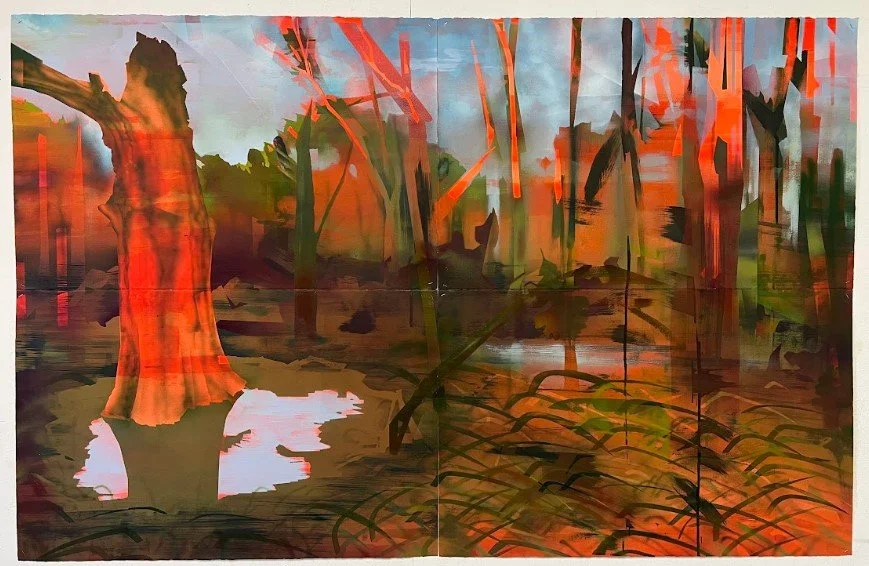
Memento Mori by Tim Stone, Acrylic and Spraypaint on Paper
Curatorial Statement
The artists featured in Edge Effect are invested in addressing the middle space between the rural and the wilderness. Equally, they are investigating the ecotones of fine art and conservative culture, the physical and the digital, and prescriptive and liberated masculinity.
Kevin Kelly’s paintings build on modern- and post-modern idioms, while building textured surfaces from carefully colored and laid dyed paper pulp in extreme neon colors that nonetheless feel like a kind of naturalistic chroma. The paintings are populated with weed-cracked pavement, stolen shopping carts, and rotting lumber structures. Kelly’s work folds together “high” cultural aesthetics and the utilitarianism of the rural.
Tim Stone's paintings are a consideration of the interstices of the suburban/rural/wilderness, as well as the interstices of physical and digital media. Picturing drowned trees standing in flooded plains, and scrubgrass and sunbaked dirt lanes, viewed through rotten wood lattice or orange plastic construction netting, his works often depict an inside looking out, and the encroachment of wilderness on built anthropic zones. His paintings are made with both brushstroke and stencils, and half naturalistic/ half neon pallets. The mashup between the sharp stencil border and the human brushstrokes, as well as the stuttering digital-glitch of the shapes in many of the pieces, evoke the uncanny blending of digital and physical media.
Justin Korver’s installations likewise blend natural and unnatural palettes. Korver’s work addresses the spectrum of masculinity, resisting toxic masculine ideologies while sorting out the positive remnants. In his work, Korver presents large tapestries, as well as hand sewn garments, printed with photographic “real tree” style camouflage imagery, stitched with neon orange thread, and at times embellished with electric orange vital organ maps, emulating hunter targets. In his work, Korver s work inhabits the brackish zone of the “human and more-than-human worlds,” where all life exists as a network that is simultaneously and continuously in a state of growth and decay.
All three of these artists converge and diverge from the borderlands of the rural and the wilderness, fine art and utilitarianism, physical and digital, traditional and liberated.
Artist Bios/statements
Kevin Kelly
Statement
This work awkwardly occupies that space between an experimental, painterly experience of the world and the unromantic surroundings of the Midwest I grew up in. That landscape is characterized by utility, heavy-handed social and political messaging, and a restrained dialect. But that world is also colored by nostalgia, natural order, and moments of joy. As I work, I dissect painting processes, looking for harmonies and discords that speak to the subjects I encounter. By taking painted gestures and my surroundings out of their normal contexts, I hope to give both a fighting chance.
Bio
Kevin Kelly is an artist and educator from the middle of America. He earned his Bachelor of Art Education in 2001, and his MFA in painting from Wichita State University in 2008. His artwork is held in many private collections across the United States and has been recognized through the Golden Artist Residency, the Mother’s Milk Artist Residency, the Harvester Arts Community Fellowship program, and the Oklahoma Visual Arts Commission. Kelly has been featured in group and solo exhibits regionally and beyond for the last 20 years. His work has been featured in several publications, including New American Paintings, Studio Visit magazine, and the book Wichita Artists in Their Studios. Kelly is currently a professor of art at Butler Community College in El Dorado, KS
Tim Stone
Statement
I am creating a painterly language emphasizing the hybridization between our physical and digital experiences. My work sutures digital efficiency and gestural inefficiency through physical marks and colors that are rambunctious, fiery, and ambiguous in their affect. There is tension between the ordinary and the superlative, between what is natural and artificial. I am examining how bemusedly liminal our physical and digital spaces have become.
Bio
Tim Stone was born in Hutchinson, KS in 1988. He graduated from Wichita State University in 2012 with a BFA in Painting. In 2014, he began his teaching career at Mark Arts and attended a drawing marathon at the New York Studio School of Painting, Drawing, and Sculpture. Since 2016, he has been an adjunct instructor at Wichita State University teaching Life Drawing, Foundation Drawing, 2D Design, Intro to Painting, Life Drawing Studio, and Life Painting, a 300 level course which he created. He created and instructed drawing and design courses at Bethany College in Lindsborg, KS and currently teaches at the Lawrence Arts Center. He is featured on episode 6 of The Hutchinson Art Center, Blue Barn Productions and HutchCC Media Crew’s short documentary series "Artists in Their Space.” He won first place in the 2021 Emerging Artists Showcase by the Wichita State Art & Design Advocates. In 2022 he was in the group show Painting at The University of Central Arkansas’ Baum Gallery and earned his MFA in Painting from Wichita State University in 2022. He created and operated Stone Gallery at the Commerce Club at The National in Wichita, KS from 2024 to 2025, showcasing works from both emerging and established artists. This year he was a visiting artist at Montana State University Billings, MT, working with students and exhibiting his exhibition “Blue Skies Behind.” His work can be seen in Wichita at Emprise Bank, Cargill, Hutton Construction, and Woolsey Hall- WSU Barton School of Business, and online at timstone.studio.
Justin Korver
Statement
My recent work is located within “outdoorsmen” culture and is informed by my experiences in a hunting family. My dad is an active outdoorsman, hunter, and my first model of traditional masculinity, a mold I do not fit. I lack the killer instinct. My education in feminist and queer theory has led me to question the masculinity I saw modeled growing up. As I navigate my own masculinity, I must sort through the toxic patterns and lay my hands on the redeeming salvage. The resulting art is an argument for inclusive ways of being and dismantling the role of man as a predator.
My expanding body of work focused on hunting and outdoor culture has led me to consider the broader ecological implications of making work in relationship with the human and more-than-human world. As I navigate these dynamics, I engage scholarship from thinkers like Timothy Morton, Robin Wall Kimmerer, Donna J. Harraway, Peter Godfrey-Smith, David Abram, Anna Lowenhaupt Tsing, and Maurice Merleau-Ponty. Their work argues for an understanding of human life in the network of life. Merleau-Ponty’s term for this network is flesh. I am now thinking of myself as part of this broad network of flesh. In this exhibition at KCAC, I want to examine the transformation of flesh as it decomposes, disintegrates, and darkens.
Bio
Justin Korver is an artist and educator in Kansas City. He is originally from a small town in the northwest corner of Iowa, and the plains of his home taught him to understand minimalism. He moved to Holland, Michigan to complete his undergraduate work at Hope College. While in Michigan, he was influenced by mid-century design and discovered a passion for hardware stores. After Michigan, he moved to Texas to pursue his MFA at the University of Texas at San Antonio, where his thesis focused on the critique of the social construction of masculinity. After grad school, He began working as a Senior Lecturer of Art at Texas A&M San Antonio, where he facilitated various courses in the theory and practice of art.
He moved to Kansas City in 2024 to accept an Assistant Professor of Foundation position at the Kansas City Art Institute. At KCAI he mentors students as they navigate the first year of their college experience. He also maintains an active research practice. He exhibits his artwork extensively with recent exhibitions at the McNay Art Museum, the Contemporary at Blue Star, grayDUCK Gallery, and Artpace. He has participated in artist residencies at the Kunstlerhaus Bethanien in Berlin, Casa LÜ in Mexico City, and Rockland Woods outside Seattle.