More Than the Sum: Building an Exhibition Through Repetition
By Babs O’Halloran Director of Operations at KCAC
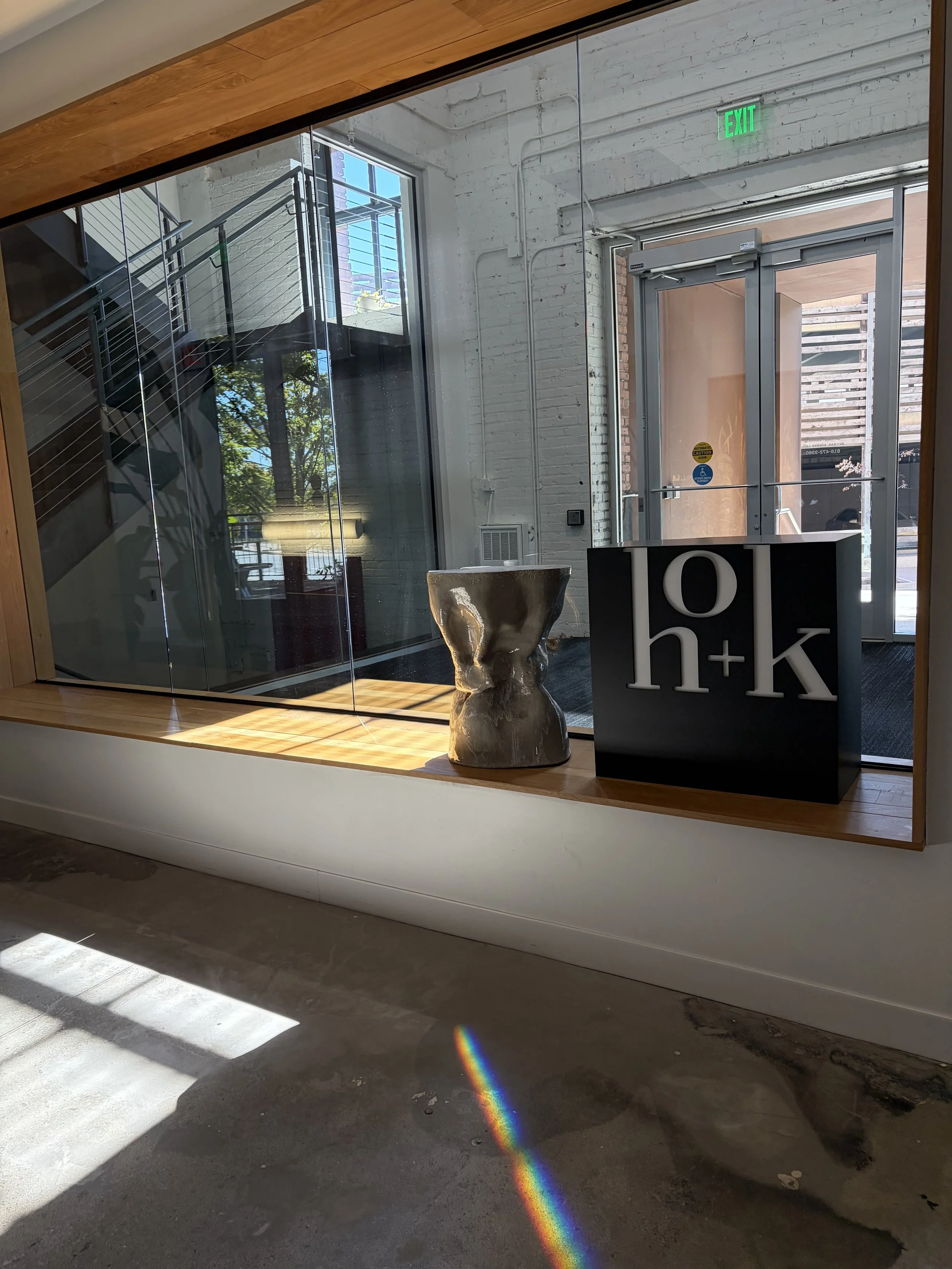
Eve Krahn artwork Plateau (1, 2, 3, 4, & 5) Stoneware, 2024-26 seen at HOK.
Kansas City Artists Coalition (KCAC) Curation Services connects artists with businesses and organizations throughout the region through professionally curated, rotating exhibitions. KCAC develops exhibition concepts, selects artists and artwork, coordinates artwork transportation, installation, didactic materials, sales, and deinstallation, with the driving force to be creating opportunities for artists to have their work encountered outside of a traditional gallery setting.
HOK has been an ongoing partner in that work. A global architecture, design, engineering, and planning firm with a substantial Kansas City studio, HOK contributes to the built environment locally and beyond through work across architecture, interiors, workplace design, sports and entertainment, civic projects, and other sectors. That makes HOK an especially interesting setting for contemporary art. Design is already part of the everyday culture of the workplace, and the exhibitions become part of an environment where people are constantly thinking about form, systems, materials, space, and how people move through and experience the built world.
For me, that means each exhibition has to do more than fill walls.
The work has to hold its own in a space occupied by people who think professionally about design, while also functioning as part of an active workplace for six months at a time.
When I started developing the next Curation Services exhibition for HOK, I was thinking about two things at once: what territory I had not yet explored in the exhibitions I have curated for their space, and how I could make the installation process more efficient without making the exhibition itself feel simpler.
Those two questions ended up leading me to the same place.
Instead of connecting the exhibition through a shared material or visual surface — something I have explored in previous HOK exhibitions. I began looking for artists whose work is built through repetition, accumulation, gesture, and repeated action. I wanted the relationship between the artists to come from something less tangible: what they do to make the work.
That became More Than the Sum.
The exhibition brings together 7 artists whose practices develop through actions repeated over time. They stack, scrape, gather, arrange, build, shape, layer, and repeat. An individual mark or form may be relatively simple, but through persistence and accumulation it becomes something more complex.
That idea became both the curatorial framework and, a useful constraint.
Starting with the action
There have been several exhibitions at HOK where material played an important role in connecting the work. That can be a really effective way to create cohesion while still allowing for variety, but I wanted this exhibition to feel fresh within the space.
Shifting the focus away from material and toward action opened up a different way of thinking.
The question became less about what the artists were using and more about what they were doing over and over again: building, stacking, scraping, shaping, repeating, assembling, gathering, layering.
That changed how I approached the artist list.
Rather than expanding the number of artists to create variety, I found myself doing the opposite. I made fewer selections and asked each artist’s work to carry more of the exhibition. That gave each artist enough room for viewers to begin recognizing the internal logic of their practice.
It also forced stronger choices.
The work had to project a real sense of repetition, accumulation, or ongoing action in a substantial way. The result is a smaller roster, but one where each artist has a meaningful presence and where the variety comes from the different ways repetition is used rather than from trying to represent as many materials or visual styles as possible.
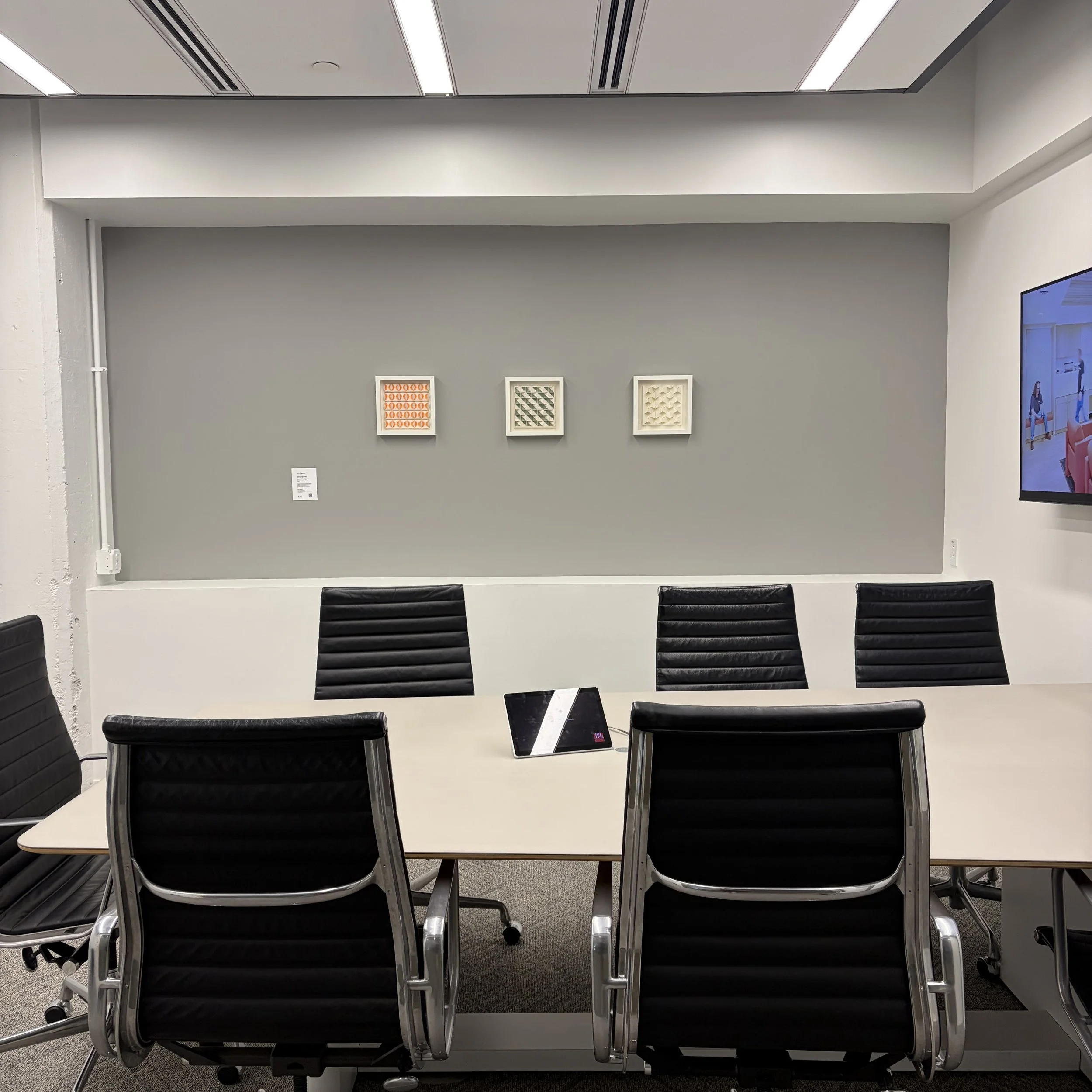
Rie Egawa artwork Breeze Block 1, 2, & 3 10" x 10" 1.75" Gouache, thread, glue on Arches - Framed 2020 seen at HOK.
Finding the artists
Rie Egawa was one of my earliest “yes” moments.
Her work helped me understand what I wanted the exhibition to do. Individual pieces maintain their own character, but repeated papers, shapes, colors, and processes create a strong visual continuity across the larger body of work. That ability to repeat without simply reproducing became important as I continued building the artist list.
From there, I began looking for different interpretations of the same idea.
Eve Krahn’s repeated ceramic forms contain far more chance and variation. They belong together, but they resist being identical. There is repetition, but also randomness and unpredictability.
Joe Bussell brings repetition through gesture. In his scrape paintings, the action itself leaves a record. The movement remains visible in the marks that are left behind, so the history of the gesture becomes part of the finished work.
Beth Flemington’s work depends on accumulation. Her ceramic forms are gathered and stacked in ways that allow individual pieces to repeat and reference one another across different groupings. The work only fully succeeds through the building up of that visual library of forms.
Lorrie Boydston also works across a cohesive body of imagery, but through a unique visual language. Recurring shapes, colors, and compositional relationships create continuity across her work while still allowing individual pieces to maintain their own identity.
Elaine Buss works with forms en masse. Her ceramic elements build into larger installations and systems, and I knew her work could create the kind of cumulative presence I wanted while also functioning successfully within HOK’s architecture and installation requirements.
Ellie Naeger’s work brings another interpretation of repeated form at a smaller sculptural scale, adding a different kind of concentration and physical presence to the exhibition.
One thing I did not immediately notice was just how ceramic-forward the exhibition had become. It was not until I shared the developing artist list with Thayer Bray, KCAC’s Exhibitions Director, that he pointed it out.
That was actually reassuring. I had not arrived at the artists by choosing a material. I had arrived at them because their actions belonged together.
A quiet seek and find
The artists in this exhibition do not make work that looks the same. I hope people begin internally tracking what repeats across the space. A shape might echo something seen on another floor. A stacked form may call back to a repeated painted mark. One artist’s systematic arrangement may sit in contrast to another artist’s more unpredictable variation. There is a kind of internal “seek and find” happening throughout the exhibition. Those relationships do not have to announce themselves immediately. In fact, I prefer that they do not. The exhibition asks for a little time, which feels appropriate for work that is itself built through repeated actions and accumulated decisions.
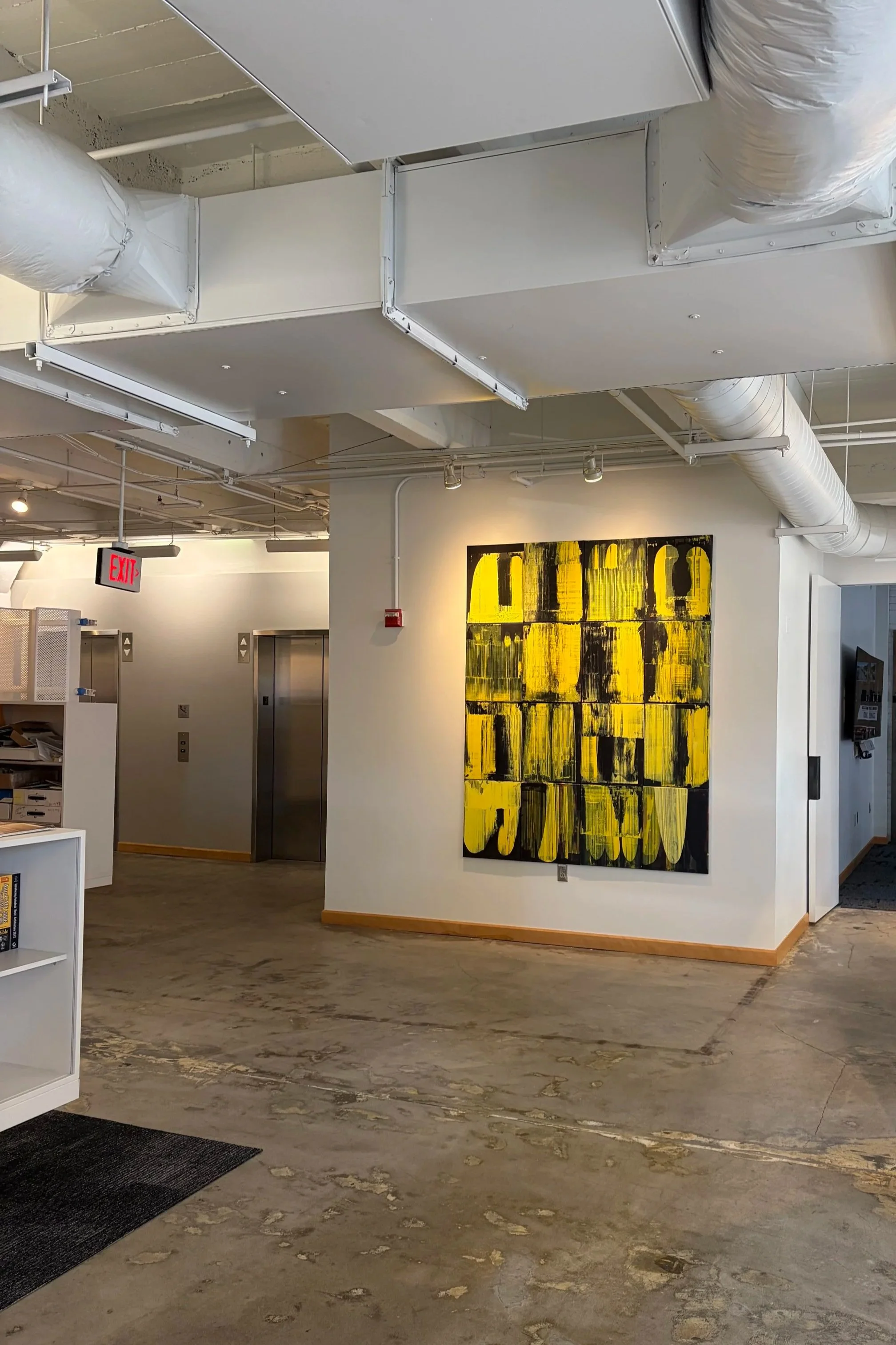
Joe Bussell’s artwork Bright Black (16) 20" x 16" each Acrylic 2024 at HOK.
Curating a lived-in exhibition
One of the things I have learned through repeatedly curating exhibitions for HOK is that an office is not simply a gallery with desks in it. These are lived-in exhibitions.
People work beside them, hold meetings near them, walk past them multiple times a day, and continue interacting with them for six months. That changes how I make decisions.
Three-dimensional work, in particular, has to be selected for a very specific location. I have to think about circulation, furniture, sightlines, what department occupies an area, what floor the work is on, and how people actually move through the building. A sculpture cannot simply look good in a particular location. It has to function there over time.
The more exhibitions I curate at HOK, the more institutional knowledge I accumulate about the space itself. I know which areas can support particular kinds of work, where installation becomes complicated, where a piece will have room to breathe, and where something visually successful on paper may not function once people return to work around it.
That knowledge shaped More Than the Sum considerably.
Beth Flemington came to HOK with me before the exhibition so she could see the space where I was considering her work. She developed new configurations with that location in mind. During installation, she noticed how the colors she had chosen interacted with the couch nearby — a relationship that could only happen because the artwork had entered an environment with its own visual life.
That is one of my favorite things about Curation Services.
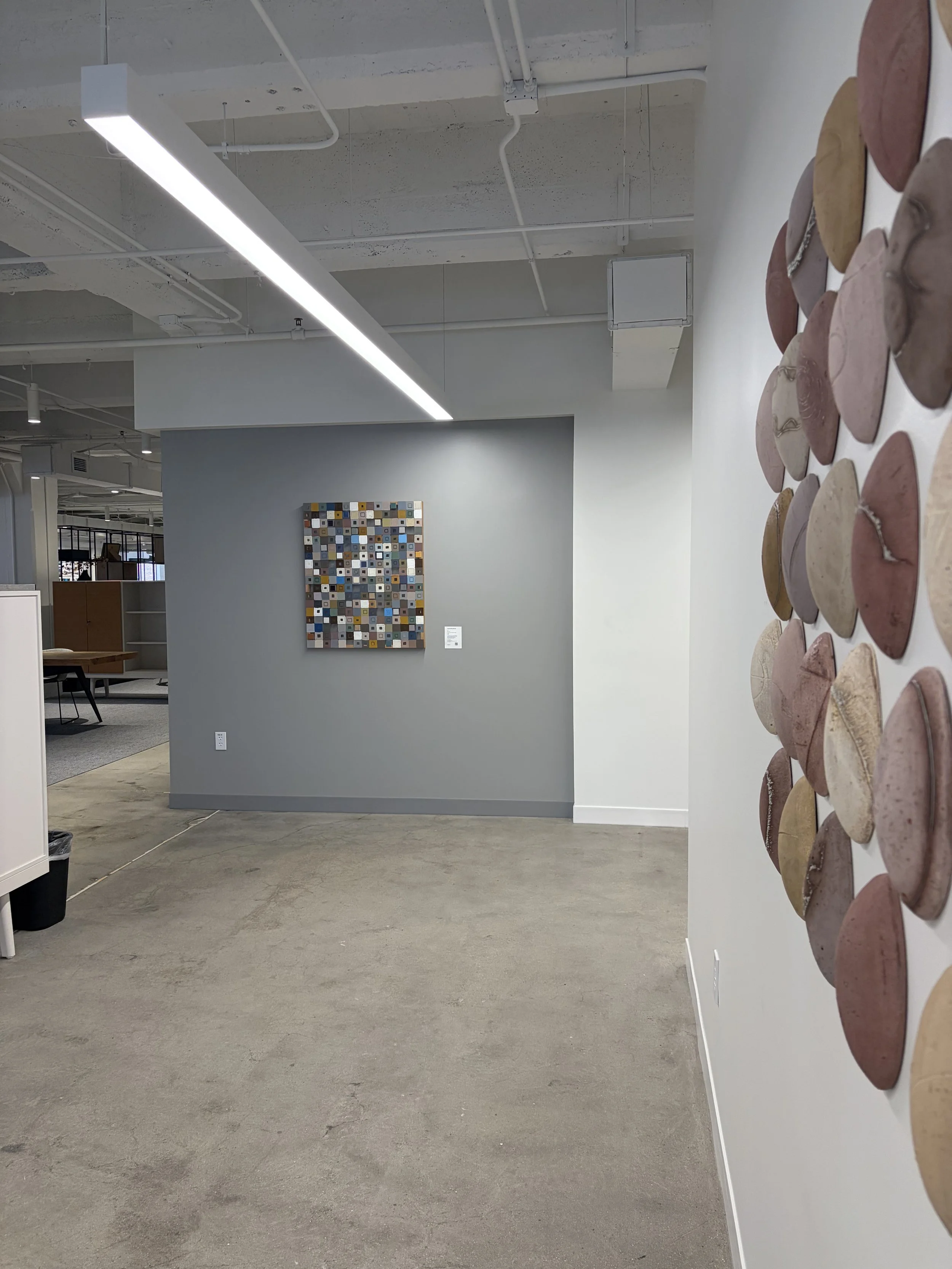
Lorrie Boydston 24 28" x 30" Acrylic mixed media on clear panel, 2024
Elaine Buss Breathe Before (Birth/Growth iteration) 3'5" x 5'10" x 2" Ceramic, terra sigillata, melted minerals & glass frit, 2023
Art outside the gallery
I think about the difference between experiencing artwork in a gallery and living with it in another setting as something like the difference between seeing a garment on a runway and then seeing it worn on a red carpet. It is the same object, but the context changes how we understand it.
A gallery asks you to enter with the specific intention of looking at art. At HOK, the work becomes part of someone’s day. You may pass it on your way to a meeting, notice something new about it three months later, or discover that a piece you had barely registered at first has slowly become familiar.
That makes the artwork feel less removed from everyday life. It also gives artists opportunities to be seen by people who may not have encountered their work otherwise.
My hope with every Curation Services exhibition is straightforward: I want artists to sell work, and I want the exposure to create future relationships and commissions. The artwork gets the chance to be lived with in a way that simply cannot happen in a traditional gallery setting.
When planning becomes part of the exhibition
One of the unexpected successes of this exhibition was how efficiently it came together physically.
Despite several works involving repeated elements and grid-like arrangements, the installation moved quickly. That was not because the work was less complex. It was because the planning was better. The artist drop-off flow worked well. The smaller roster reduced unnecessary complexity. Several artists arrived with thoughtful templates or installation resources already prepared.
There is a lot to be said for artists who think in patterns and systems and then bring that same kind of thinking to the way their work is installed. That preparation made a real difference. There is also something fitting about the fact that the exhibition itself was built through accumulation. The same logic that drives the artwork also shaped the way the exhibition came together.
More than the sum
The title More Than the Sum ultimately describes both the artworks and the exhibition around them.
A single scrape, folded piece of paper, ceramic unit, painted mark, stacked form, or repeated gesture may appear modest on its own.
Repeated, altered, accumulated, and placed in relationship with others, it becomes something else.
That is what I wanted this exhibition to hold onto. Not simply what an artwork is made from, but what happened in order for it to exist. And perhaps, after enough time living alongside these works, viewers will begin noticing those repeated actions hiding in plain sight.
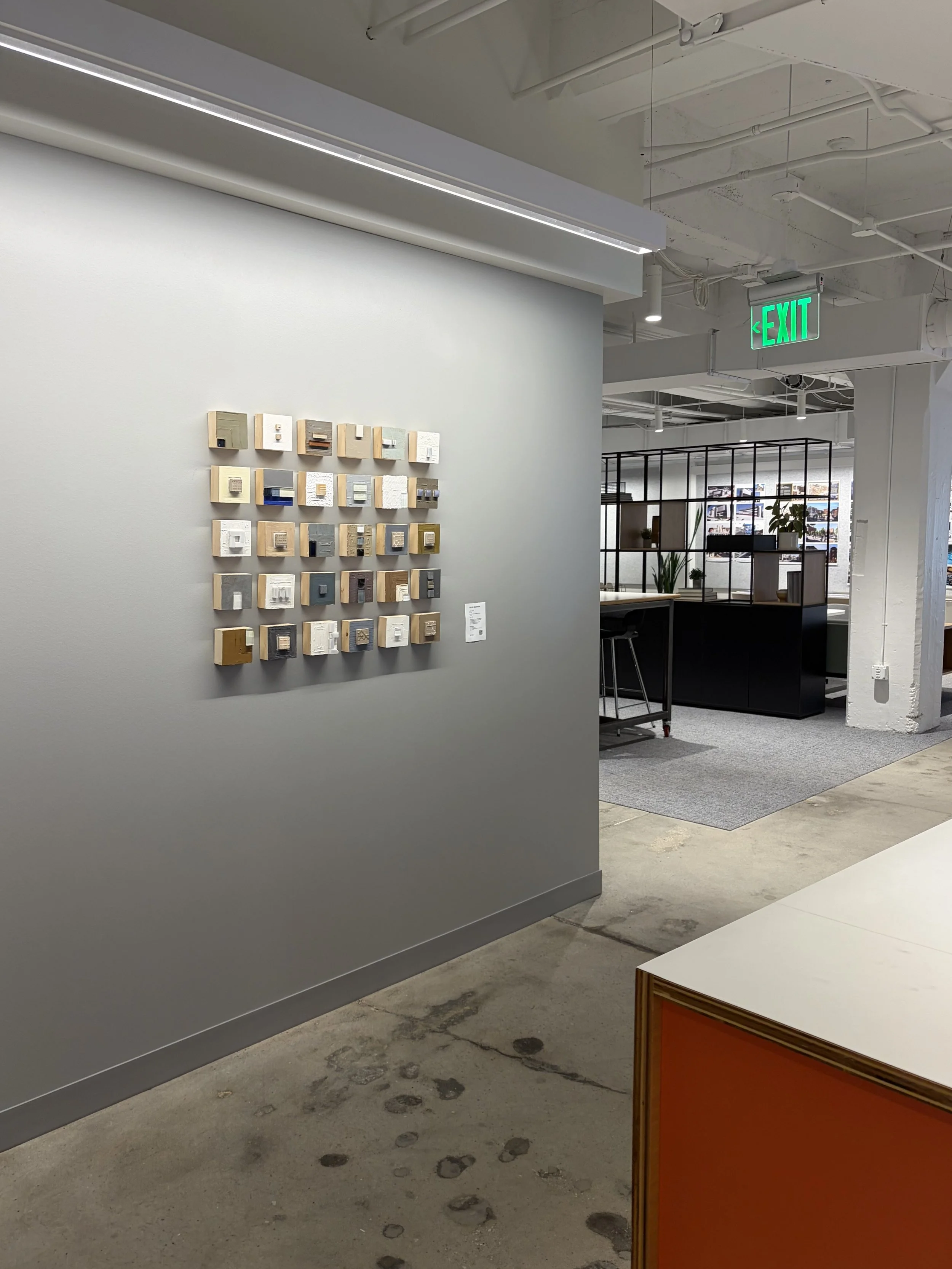
Lorrie Boydston artwork Little Ones (B) 4" x 4" each Acrylic mixed media on wood panel, 2019 -25 at HOK.