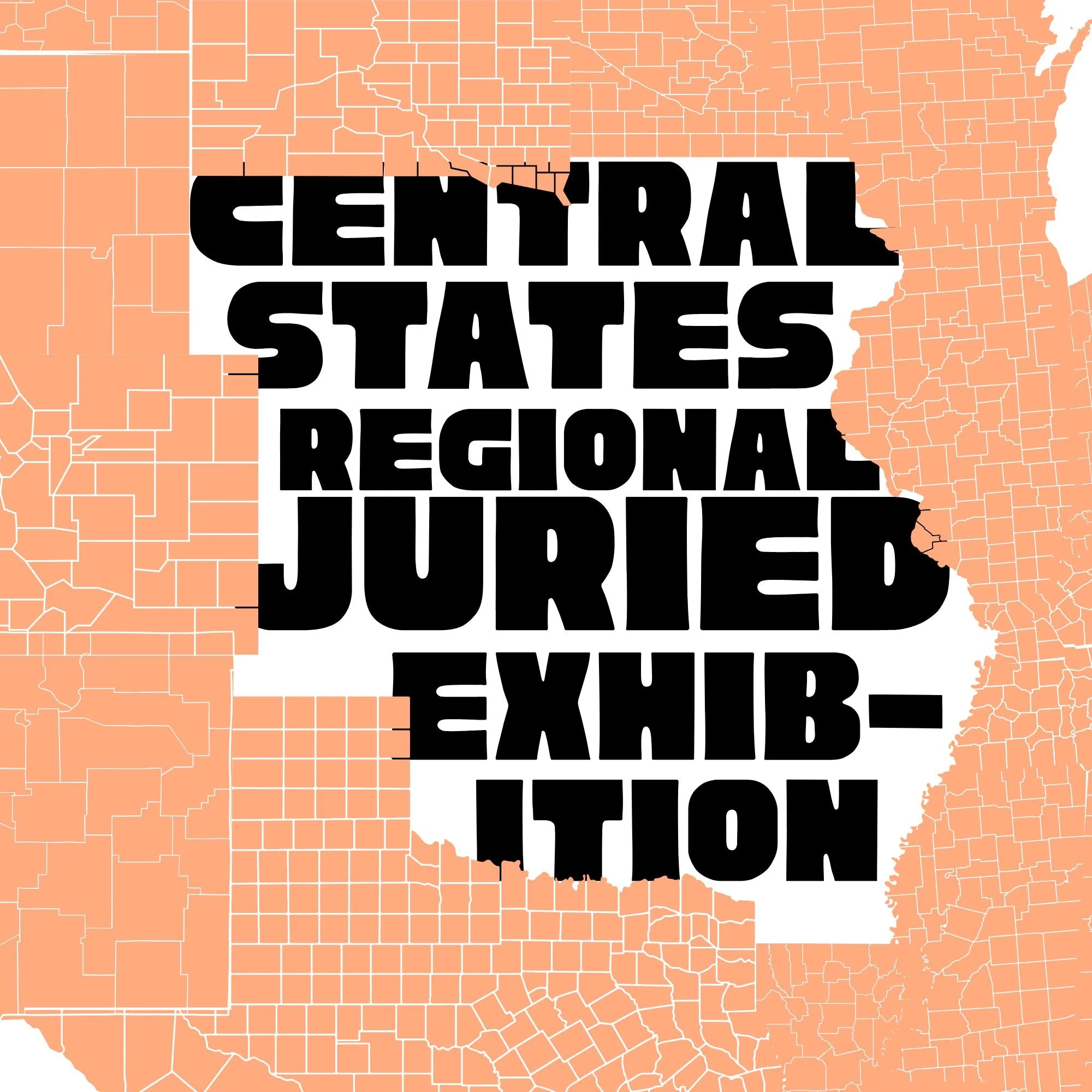
Main Gallery, November 20 - December 19, 2026
Preview Reception: Friday, November 20, 2026, from 5:00 – 8:00 PM
Opening Reception: First Friday – December 4, 2026, 5:00 – 8:00 PM
The Kansas City Artists Coalition (KCAC) Central States Regional Exhibition is a juried exhibition designed to highlight outstanding contemporary artwork being produced throughout the Central States region of the United States. Open to artists at all stages of their careers, the exhibition seeks to foster regional dialogue, expand visibility for artists working outside major coastal art centers, and strengthen artistic connections throughout the Midwest.
The exhibition will feature work from artists residing in Kansas, Missouri, Iowa, Nebraska, Oklahoma, and Arkansas. Through a rigorous jurying process led by Alice Gray Stites, (Former Museum Director and Chief Curator of 21c Museum Hotels, and currently director of AGrayStites Projects), the exhibition aims to present work that demonstrates exceptional visual, conceptual, and technical merit across a broad range of contemporary practices.
KCAC’s goal is to position the Central States Exhibition as a leading regional exhibition opportunity that supports artistic excellence, community engagement, and cross-state cultural exchange.
Alice Gray Stites is a curator and arts leader recognized for developing influential exhibitions and site-specific commissions that engage contemporary culture and public audiences. She is the founder of AGrayStites Projects, an initiative dedicated to curatorial, advisory, and advocacy work with artists and cultural organizations.
From 2012–2026 Stites served as Museum Director and Chief Curator of 21c Museum Hotels, a multi-venue contemporary art museum operating across several U.S. cities.
-
Maryanna Stark Adelman
Biography
Maryanna Stark Adelman earned her BFA in Painting from the Kansas City Art Institute and her MA in Painting and Printmaking from the University of Missouri, Kansas City. She has exhibited widely in the Kansas City area, including The Bunker Center for the Arts, Habitat Gallery, ArtsKC, The Late Show Gallery, the Nerman Museum, and the Kansas City Artists Coalition.
Her work is in numerous collections including the Daum Museum of Contemporary Art. Maryanna currently teaches drawing at the University of Central Missouri. Her work may be seen at maryannaadelman.com or on Instagram @maryannaadelman.
Statement
With the cyanotype process, I explore the ideas of documentation and slippage. Photography traditionally aims to capture a moment, to document truth in a tangible form. On the one hand, the cyanotype process provides straightforward, graphic documentation of a very specific botanical specimen. On the other hand, an ambiguity emerges. There’s an inherent impermanence and unpredictability in both the process and the world around us. Slippage is recognized where the logic and rationality break down.
The Garden Series celebrates not the purposefully planted and carefully tended plants, but the unintended “weeds” that find their way into the landscape uninvited. They are celebrated and documented in all their glory.
-
BIO:
Nada Bayazid is a second-generation Syrian-Lebanese American artist born in Kansas City. Bayazid’s work is driven by unique personal interpretations of identity, memory and place, explored primarily through painting and printmaking. On a journey to reconnect with her identity within the Arab diaspora, Bayazid’s use of family photos, unique symbols and text to create an entryway to a much larger conversation about loss, longing and cultural hybridity.
Nada Bayazid received her BFA in Visual Arts from The University of Kansas, Lawrence, Kansas in 2024. Bayazid has exhibited solo shows at Vulpes Bastille, 3West KC and The Waiting Room in Kansas City, Missouri. Bayazid has also exhibited in group shows at The Spencer Museum of Art in Lawrence, Kansas and at Anderson Ranch Arts Center in Snowmass Village, Colorado. She currently lives in and works from Overland Park, Kansas.
ARTIST STATEMENT:
My work is driven by personal interpretations of identity, memory, and place, explored primarily through painting and printmaking. I draw connections between these broad themes and my own experiences as an Arab-American within the diasporic vacuum, using childhood photographs, a unique understanding of cultural and historical symbols, and various painting and printmaking techniques.
Growing up in the US, my perception of the Middle East was shaped by stereotypes that painted it as regressive and ruinous. However, through unlearning and reevaluating these narratives, I have begun to reclaim a deeper awareness of my history and identity as an Arab-American. This process manifests in images that challenge Western intervention in the Middle East while offering a more nuanced understanding of my own cultural hybridity. By layering my American upbringing with fragmented memories and an evolving relationship to Syria and Lebanon, I have developed a symbolic visual language, creating objects and spaces that embody the complexity of my identity.
Ultimately, my work is both a personal reckoning and an act of recovery- an effort to reclaim origins, interrogate assumptions, and find meaning in the fluid spaces of diaspora.
-
Ang R. Bennett (b. 1990, Little Rock, AR) is an interdisciplinary artist, curator, certified doula, and queer activist. Bennett holds a BA in art history from the University of Nebraska at Omaha. Bennett explores identity through personal narrative and inherited history.
In March 2026, Bennett curated BLACK but not the ART: Breaking the Frame, an exhibition bringing together Black artists from across Nebraska whose work challenges narrow definitions of Black creativity and shapes how the region's art histories are formed and remembered.
Bennett has exhibited locally, regionally, and internationally, including at AfroFest Taipei. Notably, Bennett’s work was featured in the Stonewall National Monument Visitor Center, the first LGBTQ2IA+ center within the National Park System, where it was displayed during the center's first year of operation.
Bennett is deeply embedded in the Omaha arts community, serving in leadership roles across several organizations, including BFF Omaha, Amplify Arts, Opera Omaha, and Voices in Alliance, Omaha's first and only LGBTQ2IA+ theatre company. Bennett is the immediate past Visual Arts Chair of the Omaha Entertainment and Arts Awards.
artist statement
I am Black. Queer. Agender. Southern-born. Raised between the South and the borderlands of Detroit.
I often find myself chasing a sense of belonging to a given place, a frozen moment in time, an identity that isn’t shackled.
My practice incorporates painting, assemblage, and digital media as a call-and-response to personal and inherited history. The materials are important to the process; acrylic paint is fast-drying and tougher to manipulate, repurposed clothing from my closet serves as a thread between self and composition, and gold metal leaf denotes the fragility and permanence of memory.
My work is a place to stop chasing, to explore, to rest, to sit in joy. I create sites that counter intergenerational trauma and intersectional oppression.
“What would it look like if we were free?”
-
Why do I paint?
To delineate an interpretation of the visual world is a process of comprehending the balance, tensions and wonder of life. Degas said, “Painting is not what you see but what you make others see.” When I paint the landscape tension is created as I strive to portray reality as faithfully as possible within an environment that is constantly changing. Painting helps me to connect with the beauty and immense genius beyond even that which can be seen. To capture the gentle angle of a particular branch or express the glimmer of light dancing across a plume of foliage is but a reflection of a yearning for something more.
There is an unquenchable desire to grasp at this sense of reality, meaning, and eternity alluded to by this scene in front of me. The study of rejuvenation and decay finds its balance in humanity. The Missouri landscape, so characteristic of its rolling hills and deep penetration of green, is enthralling. Cezanne once said, “Painting from nature is not copying the object but realizing one’s sensations.” To see and study nature, to analyze, to somehow capture it on canvas, is exciting and animates me. I seek to bring a sense of what has been before my time and what will continue to be after it, to my work.
I have found great inspiration in artists such as Cezanne and Monet. More recent artists include the works and thoughts of Wilbur Niewald, Wolf Kahn and Stanley Lewis. I seek to emulate what seems to me to be a faithful search in one’s painting, thinking and being.
-
Bio
Carlos Beristain was born in Lynwood, California, on October 6th, 2004. At the age of 1 he moved to Berryville, Arkansas, and spent his younger years there. He got accepted with a scholarship to the Kansas City Art Institute (KCAI) and is currently studying to receive his BFA in sculpture. He specializes in creating pieces that are intensive towards his body. He explores the ideas of memories, changes, and culture to create bodies of work that ties into his ancestral past. It consists of the harsh labor that he witnessed during his youth, while also involving his work from being in a rural but never-ending thought of his hometown. He utilizes wood, metal, and found objects to discuss his current perceptions of the world. He wants to further his education by applying to residency programs and with the hopes of a solo-exhibition in the future.
Statement
I explore memories, and feelings of nostalgia associated with being a son of immigrant parents. My newest work revolves around exterior “auto-body” parts and the connection I see between skin and metal. I’ve been etching these parts with imagery and elements from my hispanic culture. The etchings connect to religion, stories, extensive-working class ethics, and the major change of lifestyle I’ve experienced being a first-gen student. I aim to constantly involve myself in labor-intensive processes, such as making use of found objects, wood, metal, and graffiti techniques that involve skills I learned in my youth or even new skills to embody my emotions. To find the answers to the questions of my civil status, emotions, beliefs, and or the current world problems. By creating and breaking current perceptions of rules, expectations and or consequences to bring that loss of memory into the real world.
-
Bio:
Savannah Bustillo (she/her) is a queer, second generation, Colombian-American printmaker, bookmaker, and papermaker from Albuquerque, New Mexico. She combines making and anthropological investigation to explore spaces in the margins – where identities not easily reconciled are placed. She received a BFA from Washington University in St. Louis, and is completing her MA/MFA at the University of Iowa in printmaking with a secondary in book arts.
Her work has been shown throughout the US, including the Contemporary Art Museum in St. Louis, the Bradbury Museum of Art, the Cedar Rapids Museum of Art, the Dubuque Museum of Art, Anderson Ranch Arts Center, The Morgan Conservatory, Women’s Studio Workshop, and the Minnesota Center for Book Arts, where she has been both a semifinalist (2024, 2026) and finalist (2022) for the MCBA Prize. Bustillo was awarded the Jerome Emerging Printmaker Fellowship in 2021 at Highpoint Center for Printmaking and the SGCI Emerging Artist Award in 2024. She has completed residencies at Anderson Ranch Arts Center, the Hambidge Center for Creative Arts, and Haystack Mountain School for Crafts.
Additionally, she has received numerous artist grants from the College Book Arts Association, the Fine Press Book Association, the Guild of Bookworkers, and the Metropolitan Regional Arts Council in Minneapolis.
Her work is held in over 40 collections throughout the US, including Harvard, Yale, UCLA, and the Walker Art Center.
Artist Statement:
I have always known that words have stakes.
It was a sour lesson. Spreading slowly on the palate. Pulling at my nostrils when my grandpa, Yayo, would ask me whether the word in or on was more appropriate for the bank teller. Pricking my tongue when my second grade teacher was unable to get the J of my father’s name right at parent-teacher conferences.
There was a symmetry to its notes of caustic bitterness. My relatives would struggle to pronounce the a’s of my American first name, just as each of my grade school teachers struggled with the double l’s of my Colombian last name.
These flavors still linger in my mouth.
In my work I shape metaphorical “toothpicks” — pieces that allow a small probing as individuals feel the strain of their own sociopolitical coordinates, tasting and sampling words as they stretch their mouths around them. Working across installation, print, and handmade paper, I explore how language is bound in the semantic and the mechanical, and where repeated actions and movements bring new understandings around labor, responsibility, and violence.
-
Aaron Crim is an artist living and working just outside the Lawrence, Kansas area, lately focused on expressive portraits of interesting individuals. Some of his portraiture includes depictions of artists local to the Lawrence area. Aaron attempts to draw out character features using bold strokes of decisive color, often using soft pastels. After a long stint of inactivity, the Pandemic (and increasing age) caused Aaron to rethink his first love, artwork, and get back into it. He’s been trying to reengage ever since.
-
Bio:
Grace Edwards (she/her) explores the inherent sweetness of life through her bodily lived experience and imaginative use of ceramic materials. Crafting her forms with fluid, fluxing materials, she uses her body and sweets as tools to bridge sensory experiences across time, highlighting the opportunity for joy in the ephemeral. She holds an MFA in Ceramics from the University of Arkansas and a BFA in Ceramics and BA in Dance from the University of Iowa. She has been awarded the Warren MacKenzie Advancement Award through Northern Clay Center (2026), a Graduate Student Fellowship from the National Council on Education for the Ceramic Arts (NCECA)(2026), and the Sturgis International Fellowship (2025) for her ceramic material research. Her work has been exhibited nationally throughout the US and internationally in Jingdezhen, China.
Statement:
The temporality of life pushes me to indulge in all the earthly pleasures living has to offer: the delight of biting into something sweet, the beauty in being able to get lost in the movement of your own body, the sensations of being completely enveloped in a color, and the flutter in your heart when you’re surrounded by abundance. I view these bodily sensations as my most reliable source of joy, and they have formed a filter through which all my work passes. The sweetening of my practice emerged from a fascination with cakes— fleeting objects crafted with care for the sole purpose of joy. This sparked an investigation into reimagining desserts as glazes, discovering profound connections between molten sugar and glaze's silica surface.
My artistic practice uses the body and sugary sweets as tools for bridging sensory experiences across time, highlighting the opportunity for joy in the ephemeral. I’m building an accumulation of morsels emphasizing joy and pleasure through the collaboration of past and present. Forms within the work are found through engaging with a past moment through my body; looking at what sensations arise, where they are located, and where they propel energetically throughout my range of motion, or kinesphere. The act of returning to a favored moment allows for the comfort of nostalgia amongst fabrications that are new, bridging the gap between then and now. This is explored in a systemic way, breaking down the memory into parts that are filtered through structures of chance—allowing an entire body of work to be formed through excavating one moment. This process creates space for examining the elasticity of memory- allowing for it to be stretched and reexamined, led in new directions, or merely supported by cyclical structures of time.
My work celebrates indulgence through material abundance rather than surface decoration. Instead of ornamental glazing, I infuse glaze throughout the entire making process using very fluid materials and granular glaze sprinkles that result in translucent forms that appear edible. Crafting sculptures from “structural” glazes allows the form to reflect the works inherent fluidity—altering with firing and functioning as my collaborator throughout the making process.
-
Rayne Ethetton is an oil and mixed-media artist based in the Kansas City area. Her work blends realism and impressionism, with a love for color, light, memory, and the emotional connection people have to places, portraits, and personal stories.
Rayne earned her BFA from the University of South Alabama in 1993. Her work has been shown in solo exhibitions, featured in Alabama Arts Magazine, and recognized with awards including Art and the Alabama Woman. Today, she creates commissioned oil paintings for private clients and collections, while also developing original series inspired by landscapes, city scenes, nature, and the Redwood Forest.
Whether painting a portrait, a city street, or a landscape from a cherished photograph, Rayne approaches each piece as a personal collaboration between artist and client.
-
Emerson Harman is a scientific illustrator, designer, and photographer working in Kansas City. They have a Bachelor of Fine Arts from Rowan University in Biomedical Art & Visualization with a minor in Biology and certificates in Paleo-Art and Geographic Information Systems. Currently working as an experiential graphic designer at Dimensional Innovations, Emerson helps craft design systems and exhibits for cultural institutions across the country. Independently, they create photographs celebrating the natural world that open up conversations around human impact and conservation.
This photograph, Prairie [fenced and broken], is a reflection on finding beauty and identity in the fragmented American tallgrass prairie. Once a vast sea of abundant life, farmland and ranches have cut the rolling fields into almost unrecognizable pieces. Of the approximately 4% of the original tallgrass prairie that remains, nearly two thirds are found in the Flint Hills of Kansas and Oklahoma, making prairies and preserves like the one shown here increasingly critical. The need for active conservation defines tallgrass prairies today and remains a core part of the Kansas identity.
-
Item descriptionBIO
Tessa J Harrison is a Neosurrealist painter based in Kansas City. Currently she works as Lead Production Artist and Studio Manager at Porter Teleo, a hand-painted wallpaper and textile company based in the Crossroads. From 2014-2019, she worked as a Floral Designer and fell in love with mastering the art of sculpting with flowers. Working with flowers and foliage brought a new perspective to the work she creates today, establishing a strong understanding of complex color palettes and a deep appreciation for the beauty of nature.
In August of 2026, Harrison had a group exhibition, titled “Mutually Exclusive.” This exhibit explored the relationship of jazz and painting through the art of call and response. The large scale abstract works were created with two other Kansas City artists, painting in reaction to a group of musicians playing in real time. In March of 2023, she had a Solo Exhibition, “Primordial Planets: Age of Venus,” at Vulpes Bastille.
Harrison graduated with a BFA in Printmaking from the Kansas City Art Institute in 2013. During her third year at KCAI, she was selected for a commission by the Nelson Atkins Museum to create an etching demo for the show, “Fine Lines: Whistler and the American Etching Revival.” The commission consisted of a small print, the etching plate for display, and detailed written descriptions of the process.
ARTIST STATEMENT
Standing in the depths of the forest, watching the stars glint in the inky cosmos, I listen to the buzzing of insects and haunting cries of mysterious animals in the distance. Inhaling the scent of pine and decaying vegetation, I feel most alive and connected to my body. Being surrounded by nature and feeling a profound sense of awe is the closest thing to spirituality for me. I am reminded that we, as humans, are forged from stardust, and that our cellular makeup is composed of elements from stars that exploded billions of years ago. The same cosmic ingredients that are compressed to form planets also compose the carbon in our DNA, the iron in our blood, the calcium in our bones, and the oxygen in our lungs. Chemically, we are tethered to the universe, and that cosmic dust is alive within us.
My work directly expresses our spiritual connection to both the Earth and to my inner feminine goddess. Process, material, and color dictate my practice. I begin each piece with a gestural underpainting of vibrant splatters, running watery pools, and gritty textures on a birch wood panel, cementing a color story for the piece. By experimenting with mediums like sand, mica flakes, fluorescence, interference, and metallic pigments, I embed literal elements of the Earth into the canvas. Tactile textures evoke ancient paintings on cave walls. The flash of metallics and mica makes a painting feel alive with movement and spark, mimicking precious gemstones and minerals. Interference inks capture the otherworldly glow of natural bioluminescence in nature.
After my underpainting is dry, I project and collage images together. Hunting for photographs online taps into my primal foraging instinct, satisfying the desire to find the perfect “shiny pebble” when worldbuilding my compositions. As we enter into the age of AI, projection becomes a seemingly primitive tool. Sitting in my darkened studio, I visualize myself as a prehistoric woman, placing her hand on a cave wall and tracing its outline with ochre from the Earth.
As seen in Paleolithic Venus figurines, people of the Stone Age recognized that women hold an inherent connection to the Earth and that their bodies mirror the patterns of the natural world – observing celestial movements, lunar phases, and cycles of the seasons. Painting the female figure allows me to harness my power as a woman. Mythology and symbolism form the foundation of my work. As an artist of European descent, I often feel disconnected from my ancestral knowledge, driving my deep fascination for ancient art, culture, and religion. I view myths not just as stories but as a form of “proto-science” – humanity’s earliest, deeply logical attempt to explain natural phenomena using the observations and tools of their time.
SUBMISSION STATEMENT
The concept for "Spectral Cry / Echoes in Time" was born from the ethereal calls and striking plumage of the Common Loon. To ground this inspiration, my worldbuilding process began with the anatomy of a prehistoric marshland—rooting it in ancient, weeping swamp trees, delicate water lilies, and flowing cattails to construct a layered ecosystem. Further research led me to introduce other wetland birds, weaving their complex patterns into the landscape to create an enveloping waterworld of reflective, shimmering surfaces. I use water and reflections to symbolize parallel planes of existence, blurring the lines between the real and the surreal, the physical and the spiritual. In contrast to the colorful background, the central figures are left intentionally monochrome. This stylistic choice isolates them from the physical world, presenting them as spectral entities dancing through the eons of time.
-
Artist Bio
Rylie Hazelton is a ceramic sculptor born and raised on a farm in northeastern Kansas. Her sculptures show her connection to the Great Plains region and express her life story through symbolism, borrowing the forms of local wildlife. Her work has been exhibited across Kansas. She recently earned an MFA in ceramics from Fort Hays State University in Hays, KS. Upon completion, she moved back to northeastern Kansas, where she is based in Kansas City.
Artist Statement
Having sprouted alongside the plants and animals of the Great Plains region, my work is driven by my passion and appreciation for the natural world around me. I define my work as expressive naturalism, meaning that while I form the animals in my work to a recognizable quality, I use their symbolism to create a space to tell a story of my personal life experience. The figures in my work embody feelings of trauma, anxiety, and stress, as well as love, growth, and community.
-
ARTIST STATEMENT
I’m Bekah, and I create fiber art—specifically quilts and appliqué—to explore my intersecting identity as a “Scotch-Irish,” queer woman from the Arkansas Ozarks. Crafting with fabric allows me to honor a deep lineage of regional storytelling while expanding who gets to be a part of that narrative.
My imagery relies heavily on the symbols embedded in rural life. I stitch superstitious motifs like crows to evoke the folklore of my childhood, alongside socioeconomic markers like orchards to reference the labor, land, and survival of my family. By layering traditional quilting techniques with contemporary appliqué, I map out the complex landscapes of my home and also my concept of self.
My physical process mimics the way identity is constructed—piecing together disparate materials to build a cohesive whole. Ultimately, my work serves as a visual archive. I try to stitch personal and collective stories into cloth, transforming a functional folk tradition into an intimate canvas for queer visibility and Ozarks pride.
ABOUT “CROWS AS AN OMEN OF CHANGE”
In the Arkansas Ozarks, crows were boundary watchers, weather prophets, and keepers of secrets. They signaled rain and winds of change, bad luck, a good harvest, or even death. The number in a murder told a warning or a blessing. For me, crows are also a small nod to my own heritage. In this piece, I tried to stitch their almost supernatural wisdom into a snapshot of my present reality.
This murder is chaotic and multidirectional: a storm sign. Like the current moments of my own life, these crows signal that things are shifting under my feet. They're a reminder that I’m in an era of loss and transition—not unlike many of my neighbors. If you look closely, you might sense that these creatures are stirring up a soft knowing in the bones of a hillbilly that isn’t running from her roots—or herself—anymore.
I chose patterned fabrics that my late Nonnie gave me, coupled with vintage fabrics from strangers’ nonnies to complete this piece. I deliberately chose a dark background so the crows would blend into and out of the environment, mimicking the feeling of looking into a dense forest at dusk where things are felt before they are clearly seen or known. In my mind, there’s something a little magical about the real superstitions and oral traditions that are passed down through the hills of the Arkansas Ozarks.
-
Art Bio:
Maddie Hinrichs is a visual artist based in Lincoln, whose work explores the emotional and psychological complexities of domestic spaces through oil painting and embroidery. She received her MFA from the University at Albany in 2022, where she was awarded the Distinguished MFA Thesis Award, and her BFA from the University of Nebraska–Lincoln in 2019.
Hinrichs has exhibited nationally in both solo and group exhibitions, including Lead Me to Loose Me at Lux Center for the Arts, In Praise of Shadows at Project Project, and the 2025 Miami University Young Painters Competition, where she received second place. She completed a two-year residency at the Lux Center for the Arts, where she is now the Gallery Specialist. She has held teaching positions at the University of Nebraska–Lincoln, Midland University, and Ashland University. Across all her roles, Hinrichs remains committed to investigating the boundaries between illusion and reality, and the ways we construct and respond to personal spaces.
Artist Statement:
Hinrichs’ work explores the psychology of interiors through oil paint and embroidery. These mediums establish a balance that endures throughout her practice: surrealism and realism, textile and paint, dreams and memory, old and new. Complicated reflections create the semblance of deep space contained within the surface of the work. Her surreal domestic spaces bring disparate perspectives together around open and closed doorways, offering entrance into new realities. At times, embroidery stands distinctly apart from the painted surface; at others, it recedes into the surrounding colors. Delicate, detailed paint is interrupted by thick, controlled swathes of impasto and rough, textured threads, challenging and reinforcing the illusion of paint.
In her latest series, Hinrichs invites viewers to reconsider their surroundings by contemplating the degradation of images and the loss of context surrounding their sources. Through the fusion of embroidery and paint, she challenges perceptions of two-dimensional surfaces, encouraging a renewed awareness of texture and illusion. Her process involves projecting images of spaces into her apartment, photographing the resulting intersections, and manipulating these images through embroidery and paint. Focusing on surreal junctions within domestic interiors, she combines vibrant colors and layered projections to transform familiar spaces into unfamiliar visual experiences.
-
Artist Bio/Statement
I’m a ceramic artist and musician based in St. Louis, Missouri, and my work is rooted in anongoing fascination with the systems and processes that govern and shape living things.I studied Biological Science and Fine Art Ceramics at the University of Missouri-Columbia (BA, BFA, 1997), concentrating in evolutionary and ecological science and studying ceramics under Bede Clarke. I earned my MFA in ceramics at Washington University in St. Louis in 2001. I then spent two decades in estimating, management and administration for architectural materials and custom trailer manufacturers, but I never stopped feeling the need to make art and music. Today I work full time from my studio at the Foundry Art Center in St. Charles, Missouri.
My scientific background shapes how I approach ceramics: as a way to visually explore relationships between mind and body, humans and the natural world, and organisms and the environments that shape them. Rather than illustrating scientific concepts directly, I use improvisation and abstraction to suggest these dynamics, letting form, texture and gesture represent growth, adaptation and interaction.
Clay feels inseparable from these ideas to me. It is the earth, and working with it becomes a reciprocal act: molding the material or environment that, over time, molds us - as many organisms do. I’m drawn to its plasticity and the way it records touch, preserving evidence of movement, pressure and decision-making.
In my functional work, I see pottery as an extension of the primal acts of eating and drinking. By altering simple forms and embracing irregularity, motion and imperfection, I aim to elevate utilitarian objects into tools that engage the user on an emotional level. I want these pieces to feel alive rather than manufactured, inviting a more conscious, tactile connection between the user and the object.
Outside the studio, I’m a competition bagpiper and have played with the St. Louis Caledonian Pipe Band since 2004.
-
Bio
Carly Johnson is a 22-year-old artist and University of Missouri-Columbia graduate pursuing a career in mental health counseling. Their early training in dance shaped their engagement with movement, focus, and the negotiation of tensions, while their studies in psychology inform how they explore human experience and malleability. Through materials and process, Carly investigates the balance between endurance and fragility, structure and fluidity. Their work reflects the negotiation of binaries and the fluidity of self, rendering personal inquiry into physical form.
Artist Statement
I make mixed media pieces that explore the futility of binaries, natural intervention, and the malleability of human circumstance. I am drawn to rugged “femininity,” the rawness of gender nonconforming experience, and the ways people carry multiple selves at once. I am motivated by the mind’s adaptability (power). I beg for answers: How can someone exist as both fluid and firm in their identity? How can stability and change live in the same body without canceling each other out?
I work with raw structural materials like metal, wax, joint compound, and wood because they carry weight and tension in their forms. I choose materials based on how they can embody the halves of a divide I am exploring. I care about reducing waste, and that choice folds naturally into my focus on adaptability. What breaks becomes part of the next piece. What remains becomes part of a continuing conversation. My materials feel like a product of the conditions I am working through, both emotional and environmental, and the work becomes a way to move that intensity into something physical.
Across my practice, I return to the ways systems and inherited pressures shape bodies and their subsequent identities. I make work that examines how those forces settle in the body, how they endure, and how they can be undone. I look at how constructs intervene in human life, sometimes gently, and oftentimes violently, and how the natural world persists around and through them. I am interested in the balance between what is rigid and what yields, what is lasting and what dissolves, and how our reality is negotiated in that space. I want viewers to feel discomfort in the subtle assumptions that operate beneath identity. I urge for critical reflection on the pressures absorbed and consideration of what might shift if those pressures loosened. My hope is that the work creates space for a form of authenticity that comes from somewhere shifting, personal, and alive.
-
I am a visual artist based in Kansas City, Missouri. Working primarily in figurative drawing and painting, including watercolor and oil painting, I explore the complexities of womanhood through imagery that examines gender roles, identity, vulnerability, and power. My work serves as both personal reflection and social commentary, using the human figure to question cultural expectations and the often-unspoken experiences of women.
Rather than illustrating specific narratives, I create emotionally charged scenes that invite viewers to consider the tensions between strength and fragility, visibility and invisibility, autonomy and expectation. My figures occupy spaces that feel both intimate and symbolic, allowing room for multiple interpretations while addressing broader conversations about the roles women are expected to inhabit.
My process often begins with expressive watercolor washes that establish mood and atmosphere, followed by layers of graphite and colored pencil that gradually build detail, texture, and emotionaldepth. I also work in oil paint, exploring its rich colors, textures, and expressive possibilities. Across these mediums, the interplay between fluidity and deliberate mark-making reflects the contradictions
I explore in my work—softness alongside resilience, beauty alongside discomfort. For me, art is a way of asking questions rather than offering answers. Through my figurative work, I seek to create space for dialogue about the lived experiences of women, encouraging viewers to reflect on the social structures, expectations, and emotional realities that shape how we see ourselves and one another.
-
Hannah Lane graduated from Kansas City Art Institute with a BFA in Painting and Art History. Hannah Lane is a Kansas City native and lives in the Kansas City metro area. She is a female artist who explores the connection between technology and our lives.
Everywhere we are, there are grids. We constantly interact with grids. Here are some examples. Pixels form into small, solid colors that combine to make a bigger picture of what we see on our phones, computers, tablets, consoles, and TVs. The structure we live in is also a grid. In the United States, our infrastructure is based on a gridded system. You can go up or down a block, or left or right. The “block” refers to a square or a gridded formation. You can live on or off the grid regarding technology and electricity. We can have problems with “The Grid” or live in a gridded system.
Grids influence us in many ways because of our constant interaction with them. They affect where we live, how much electricity we consume, our thoughts and ideals, and even our realities. Grids have become intertwined with us as modern humans. I question the use of technology in my art and observe its benefits and drawbacks. These parts have helped shape both Western culture and global society. Grids are one of the many ways technology passes information to other equipment alongside code. I use grids in my work to pass my findings from me to the viewer in a different, more abstract way of conveying information.
Colors are fundamental in my work. They help enhance the abstracted language in each piece. My colors come from anything that can be viewed through a technological system, which connects back to gridded infrastructure. Historically, towns and cities have used color-coding and zoning to section land for commercial and residential use. The colors in my artwork block out areas of information from another source.
I am also connecting older artists' techniques, such as shading, Unione, and glazing, to create a look of form while still using modern materials, such as acrylics and synthetic hairbrushes. This interesting juxtaposition of traditional techniques with modern technology, code, and colors from the ‘cloud’ allows me to question how the grid and technology have enabled us to see places and people that would have been visible only in person years ago. While this may be good to a certain extent, the grid also disconnects us from our humanity. This combo of Renaissance shading techniques helps to bring the hand of a human being back into an abstract piece that uses technology and gridded geometry instead of just a solid color.
Through these techniques and shapes, I am recognizing my relationship to technology. My pieces process what I see on social media, TV, and news channels. How have these grids affected me personally and shaped my reality? The pieces' names coincide with the pictures from which the colors come, along with my feelings about what has been seen. These pieces are my version of a journal. A way to process and even heal all of the information given to me through technology and my own life.
-
Bio
Hannah Lindo was born and raised in Garden City, Kansas. She completed her Bachelor of Fine Arts degree at Fort Hays State University in 2017, and in 2022 she completed her Master of Fine Arts degree at the University of Kansas. Hannah was recently the Artist in Residence at the University of Central Missouri for three years, where she taught Painting and Drawing and was part of an artist-created coalition called the Lawrence Paint Haus. Her work explores the beauty and fear found in nature, which mirrors all parts of life.
Hannah Lindo
Artist Statement
I create paintings that capture accumulated moments found in nature. My work represents interconnected themes of growth and decay. These organic piles embody the dichotomy of "growth," in which hope and despair coexist. My work reflects the seasonal and emotional climates of everyday life, drawing inspiration from subtle color relationships I observe. Guided by intuition, I allow these experiences to shape the mood of each piece. I use shallow spaces densely packed with blooming and withering flowers for the viewer to experience the tension and harmony within growth. My paintings capture not just a single feeling or moment, but a layered collection of times, memories, and emotions, all accumulating on the surface like fallen leaves beneath a sycamore tree. The scale of my work shifts with each painting, echoing my desire to understand the pictorial space. Some pieces develop gradually, accumulating like debris, while others burst forth as swiftly as the first buds of spring. Frequently, one form of growth overtakes another in the form of color, texture, or imagery. Symbolizing the shifting balance between feeling excitement and being overwhelmed by the abundance of information we take in every day.
I believe paint can reveal inner thoughts and emotions, sometimes before we are even aware of them, reflecting our truest experiences. Painting is like a dance: I move with the paint as though we are partners, each guiding and surprising the other. Nature and painting share an unpredictable, ever-changing quality that requires a quiet yet focused presence to witness. What remains constant in life and painting is the uncertainty — and how we respond to it. Wild curiosity and enduring hope keeps me looking for beauty in the raging unknown.
-
BIO
Cassandra Liuzzo (she/her) is a mixed-media fibers artist and art educator. After closing the beloved new-and-used art supply store she owned and operated in her North Carolina hometown, Cassandra relocated to Lawrence, KS, where she is now pursuing an MFA at the University of Kansas. She has exhibited at galleries across the country including Kinhouse Gallery (Ft. Wayne, IN), Greensboro Project Space (Greensboro, NC), and Smith Gallery (Boone, NC); and has completed residencies Officina Stamperia del Notaio (Tusa, Sicily, Italy), Elsewhere Museum (Greensboro, NC), and Greensboro Residency for Original Works.
ARTISTSTATEMENT
My Cardboard Quilt series features pieced designs made from repurposed cardboard boxes and attached with plastic retail tags. Despite the rigid material, the thin plastic attachments allow the “quilt” to have movement and drape similarly to fabric. By reusing the corrugated cardboard box, our modern shipping and storing container, these quilts are connected to the tradition of feedsack quilts made from printed cloth bags used to ship and store grain and other kitchen staples during the late 19th- and early 20th- centuries. My cardboard quilts, with recognizable clips of products and brands, are at once a document of the time and place they are made, and a look at the overwhelming abundance of our contemporary consumer culture.
-
JoLynne Martinez is a fine art photographer based in the Kansas City metro area. She has exhibited her work regionally and nationally.
Artist Statement
My background in journalism has led me to document wetlands. Almost three-quarters of these ecosystems, which are so vital to our well-being, have disappeared since the early 20th century.
Hiking in wetlands is good exercise, and psychologically I experience a state of creative flow on these expeditions. In a communal sense, wetlands are important to the health and wellbeing of everyone. Among their many benefits, they protect against flooding, absorb and purify groundwater and are reservoirs of biodiversity. It is my hope that by sharing images of wetlands with others, I might inspire a desire to love and conserve these rapidly disappearing ecosystems.
-
My artwork serves as a communication method to express emotions otherwise inaccessible because of my brain injury. Before sustaining brain and multi organ damage from COVID-19, I was a busy mom, physical therapist, college professor and academic department chair. Overnight, this virus damaged my body so severely that 4 years later I’m still homebound/ bedridden and unable to care for myself.
The loss of identity accompanied with a new physical and cognitive disability is overwhelming. My abstract painting helps me process and accept my new place in this world. When painting, I forget that I am disabled and am instead filled with a profound sense of peace. An empty canvas represents infinite possibilities and opportunities, not my day to day limitations.
I create in short bursts, a 7 minutes limit of focused creative energy while laying on the floor using tools to minimize the physical tremors. My typical mediums include acrylic, watercolor, oil pastels and graphite on canvas or paper. I would describe myself as an intuitive painter that depicts harmonious chaos, such to represent my current emotions and physical challenges. I hope to portray a message of hope and joy in a world filled with uncertainty.
-
Artist Bio
Ursula Minor is a mixed-media artist based in Lawrence, Kansas. Working primarily with 2mm seed beads and found objects, her work explores the delicate intersection of memory, history, and craft. Every bead in her intricate compositions is placed individually by hand—a deliberate process requiring precision, adhesive, and patience.
A self-taught artist, Minor transitioned her practice from craft to fine art in 2000. Her work has been showcased in numerous regional and national juried exhibitions, including the Black Creativity Exhibition at the Museum of Science and Industry in Chicago, as well as galleries and shows throughout Eastern Kansas and the Midwest.
Artist Statement
The discovery and exploration of everyday objects is the driving force behind my work. The pieces I make are placed in the canon of assemblage art. Consistent throughout my work is the use of 2mm seed beads and a styrofoam base. I use a variety of found objects and materials that are incorporated into the final form of the work to enhance the beadwork and reimagine the original use of materials. Found objects bring a unique recall of the past in a way that adds whimsy to my work.
“ad astra PER ASPERA” is an exploration of the Kansas state motto. Often the focus is placed on the stars and forgets the “difficulties.” The path to the stars is seen in a twisting manner around the 3D piece. In tandem with that path are the difficulties that have plagued many Kansans. Some of the words and imagery depicted call back to Brown v. The Board of Education, segregation, and the fight for freedom. We cannot ignore the struggles of our past and present if we truly are to make it to the stars.
-
Bio
Scott E. Murray, Jr. is an artist and Assistant Professor of Art at Missouri Southern State University in Joplin, Missouri. He holds an MFA in Sculpture from Wichita State University and a BA in Sculpture and Printmaking from Missouri Southern State University. Working primarily in sculpture and printmaking, Murray combines found wood, branches, stones, and familiar objects to create unexpected forms and relationships. His work explores the connections between nature, everyday life, and the spaces people create for themselves, finding new meaning in ordinary materials and familiar things.
Artist Statement
My work explores the spaces we make for ourselves and the things we use to fill them. Working with found wood, branches, handmade furniture, and familiar objects, I create sculptures that sit somewhere between the ordinary and the unexpected. The idea of Sticks and Stones serves as both a material starting point and a way of thinking about the things we build, the things we carry, and the things that shape us.
These works reflect on home, identity, belonging, and the quiet pressures of everyday life. A chair, a carrot, or a simple arrangement of natural materials can suggest comfort, desire, frustration, or something just out of reach. I’m interested in the tension between the familiar and the unexpected, and in how ordinary things can take on new meaning when placed in unfamiliar situations.
-
Dana Neuenschwander is a Missouri Ozarks regionalist painter and art educator whose work explores the landscapes, histories, and everyday places that shape a sense of belonging. Working primarily in acrylic, she builds paintings through energetic layers, saturated color, and expressive shifts in line and perspective. Her scenes often begin with direct observation, then move beyond literal description to hold memory, emotion, and the enduring character of the Ozarks.
Neuenschwander earned a B.F.A./B.S. in Fine Art Painting from Drury University and a Master of Liberal Studies in Art History from Fort Hays State University. She teaches drawing, design, and art appreciation as an adjunct instructor at Ozarks Technical Community College, where she encourages students to become active observers, curious makers, and confident visual thinkers.
Before returning to fine art and higher education, Neuenschwander built an award-winning career as an automotive airbrush artist. Her custom work appeared at major motorcycle events and on television, with commissions for private and public figures. That background continues to inform the bold color, craftsmanship, and narrative energy of her studio practice.
From Ridge to River brings together paintings rooted in the ridges, waterways, roads, and working landscapes of, southern Missouri. Across the exhibition, Neuenschwander considers how place carries personal and shared history— and how the familiar can become luminous when seen with renewed attention.
-
Eavan O’Neil is a mixed-media artist who creates large-scale paintings using acrylic, oil, and layered textiles. Her work has been featured in Saint Louis, across the country, and internationally, including four solo exhibitions at The Sheldon, Edwardsville Village Hall, The Neon Art Museum of Saint Louis, and The Korpo Resident Gallery in Finland. O’Neil also participated in a touring three-person show exhibited across two states, shown at The Saint Louis Artists’ Guild and The Durham Art Center. Most recently, her work has shown at Public Defender, Trust Gallery, and at the Angad Biennial.
Outside of the studio, O’Neil is deeply engaged in arts education and community outreach. She teaches drawing, painting, and printmaking at John Burroughs School, the Saint Louis Artists Guild, and the Edwardsville Art Center. At John Burroughs, she also sponsors The Review, the student art and writing publication, and helps direct The Bonsack gallery. A graduate of Southern Illinois University-Edwardsville, O’Neil holds a BFA in painting and a BS in psychology. She currently lives and works in Saint Louis, Missouri.
Artist Statement
The quiet, repetitive tasks of domesticity—folding laundry, washing dishes, tending to a home—take up a massive share of our lives. Though unglamorous, we march to the rhythm of these endless cycles. My work imbues daily burdens with magic and whimsy proportionate to their weight as lifelong rituals.
Bright neon pigments in underlit settings give common objects a supernatural feel and ethereal glow. Reflective shiny surfaces further distort the familiar into the uncanny. A pan warps other dishware and the surrounding kitchen into a fluid jumble of color and shape. Nature and plant life begin to infiltrate the space, a result of true dilapidation or supernatural transformation; man-made objects and routines either succumb to or are freed by a return to the natural world.
When my sink overflows with dishes, they weigh on me until they’re washed and put away; by the time this happens, I have more to clean—a never-ending cycle. My paintings honor the true scale of emotional energy dedicated to chores and maintenance, memorializing domestic exhaustion in moments of wonder that imagine a way to transcend this endless march.
-
Artist bio
Courtney Paz is an artist living and working in Saint Joseph, Missouri where she draws, paints, and crafts in her spare time.
-
BIO
Intermedia artist and poet, clay scofield creates multimedia work that threads poetic narrative, performance and moving image. clay’s work has been featured in publications including Black Warrior Review, Number, Wussy, and Dinner Bell. They have performed and exhibited nationally and held residencies with SAFTA, Cucalorus, The School of Making Thinking, and the JHU- MICA Film Centre. They earned MFAs in digital art (Indiana University, Bloomington) and poetry (The Iowa Writers’ Workshop). As Associate Arts Editor for Brink Literary Journal and residency facilitator, they support artists thinking collaboratively beyond discipline and in community. Raised in Tennessee, they now live in Iowa City.
ARTIST STATEMENT
As an intermedia artist and poet, I facilitate play- and process-based collaborations and create multimedia work that threads poetic narrative, performance and moving image. I explore horizons as sites of possibility and transformations: as threshold of embrace between earth and sky, as intimacy and a negotiation of boundary between bodies. A sunrise appears as light projected through shipping material. The sediment at the bottom of a coffee cup becomes a forest. Through trans reimagining, what is just beyond the line of sight holds the potential of new meaning and possibility beyond utility and legibility.
These horizons are a trans and trans interpretation of landscape traditions, where I reinterpret a historically masculine approach to landscape photography and experimental nature documentary that emphasizes sublime and imposing compositions. The objects composing the landscape are defamiliarized and transformed, through manipulation of scale, perspective, and lighting. Inspired by dark ecology, I attempt to develop an intimate relationship with these waste materials, continuously asking myself how I can facilitate their own becoming.
Inspired by Jill Johnston’s definition of intermedia, articulated as, “Re-integration. The everything as everything. The organism as totally illegal. The legality of nothing but pleasure,” I get intimate with everyday materials through commitment to DIY queer aesthetics. Resisting internalized perfectionism that hungers for polished and sanitized art products, residues of my process litter my works, highlighting the unfinished or deviant: a misread line, a poorly lit green screen, scuff marks, and eraser crumbs.
-
Artist Bio
Ariana Swann is a Venezuelan-Italian-American artist based in Manhattan, KS. Her practice is shaped by migration and inquiry. Born in Caracas, Venezuela, she studied Statistics at the University of Michigan. She began her professional life as an organ transplant coordinator. With income from that work, she was able to travel to nine countries across six continents. Still restless, she left everything behind to hike the 2,200-mile Appalachian Trail, a footpath through the mountains from Georgia to Maine. On that journey, she decided to commit herself fully to art. She received a Masters of Fine Art in painting and installation art from Kansas State University, and currently explores themes of transformation, memory, and resilience through paintings, installation, and video.
Artist Statement
Materially rooted in painting, my art periodically expands into large-scale installations and videos. From small, colorful works on paper to room-sized monochrome environments, I employ a cast of recurring characters like jaguars, tables, and chairs.
At times I use the work to announce how resilient I am, as with my installation The Revisitation Room, where I pasted pages torn from books ex-husband left behind onto the walls and floors of my studio. Other times the work quietly whispers that I am homesick for a place long gone. For example, in my installation 3602 Corona Drive, a hollow, glowing paper apartment. The Second Beginning is a timelapse of the destruction of paper-lantern-couch removed from the larger apartment. I took photos intermittently between wetting the couch, recording the progression as it slowly dissolved. I then reversed this process and the couch was reborn in an endless loop. Just as the couch has no clear end, neither does my process. The work is unfinishable, and I am grateful.
-
Bart Vargas is a Visual Artist, Educator, and Advocate from Bellevue, Nebraska. He received his BFA from the University of Nebraska at Omaha, and his MFA at the University of Minnesota-Twin Cities. He has exhibited nationally and internationally, and his work can be found in many collections throughout the world. His works have been featured in many publications including Sculpture Magazine, New American Paintings, and HGTV Magazine. Vargas lives in Omaha, Nebraska. Vargas serves as a Professor and Chair of Visual Arts/Graphic Arts Program at Iowa Western Community College in Council Bluffs, Iowa, as well as on several local boards of non-profit organizations.
My artworks are about a lot of things, but mostly they are about creating playful, approachable and thought-provoking images. I want them to act as artifacts and evidence of the early 21st century.
-
Artist Bio
Tiffany Zen is a Kansas City–based painter whose work explores the relationship between people, wildlife, and the natural world. Inspired by extensive travel through North America’s parks and wilderness, she creates contemporary figurative paintings that combine bold color, oil paint, and luminous metal leaf.
Tiffany earned a Bachelor of Architectural Studies from the University of Missouri and worked professionally in architecture and environmental graphics before dedicating her practice to fine art. Her architectural background continues to inform her sense of composition, space, and visual storytelling.
Through her paintings, Tiffany invites viewers to consider moments of wonder, empathy, and connection between humans, animals, and the landscapes they share.
Artist Statement
My paintings explore moments of connection between people, animals, and the landscapes they inhabit. Drawing inspiration from my travels through national parks and wild places, I create imagined encounters that blur the boundary between observation and memory. Figures meet wildlife eye to eye, children discover wonder in everyday moments, and familiar landscapes become spaces for reflection.
Working in oil and mixed media with layers of metal leaf, I combine luminous surfaces with bold color and simplified forms to create paintings that feel both contemporary and timeless. The metal leaf becomes more than ornament—it reflects light and suggests the unseen relationships that connect living beings and the environments they share.